
Akamai (Edge/SSL termination)

Best Self Hosted Alternatives to Akamai (Edge/SSL termination)

A curated collection of the 7 best self hosted alternatives to Akamai (Edge/SSL termination).

Akamai Edge SSL/TLS termination terminates and manages HTTPS connections on Akamai’s edge servers, offloading encryption from origin servers to improve performance, enforce TLS policies, and accelerate secure content delivery globally.

Alternatives List

#1
Caddy

Caddy

Fast, extensible web server and reverse proxy with automatic TLS certificates, simple configuration, HTTP/3 support, and production-ready observability features.

Caddy screenshot

Caddy is a modern, production-grade web server and reverse proxy focused on secure defaults and operational simplicity. It is commonly used as an edge server in front of apps, APIs, and containers, with automatic HTTPS enabled by default.

Key Features

  • Automatic HTTPS (ACME) with certificate issuance and renewal; supports on-demand TLS workflows
  • Reverse proxy and layer-7 load balancing with health checks, retries, timeouts, and multiple upstream policies
  • Native HTTP/2 and HTTP/3 (QUIC) support
  • Flexible request handling pipeline with matchers, handlers, and rich routing
  • Multiple configuration methods: Caddyfile (human-friendly) and JSON (full API-driven config)
  • Dynamic configuration via admin API; hot reload without dropping connections
  • Built-in observability: structured logs, access logs, metrics integrations via ecosystem modules
  • Extensible module system (plugins) for auth, DNS providers for DNS-01 challenges, additional handlers, and storage backends

Use Cases

  • Secure reverse proxy in front of web apps (Docker/Kubernetes or bare metal) with automatic TLS
  • Edge gateway for APIs with routing, header manipulation, and rate/timeout controls
  • Static site hosting with modern protocol support (HTTP/2/3) and straightforward TLS management

Limitations and Considerations

  • Some advanced capabilities (e.g., specific auth methods, WAF features, DNS providers, metrics exporters) may require third-party modules and a custom build.

Caddy is well-suited for teams that want a secure-by-default web server with minimal TLS operational burden and a clean configuration model. Its extensibility and modern protocol support make it a strong choice for both simple deployments and complex edge routing setups.

69kstars
4.6kforks

#2
Traefik

Traefik

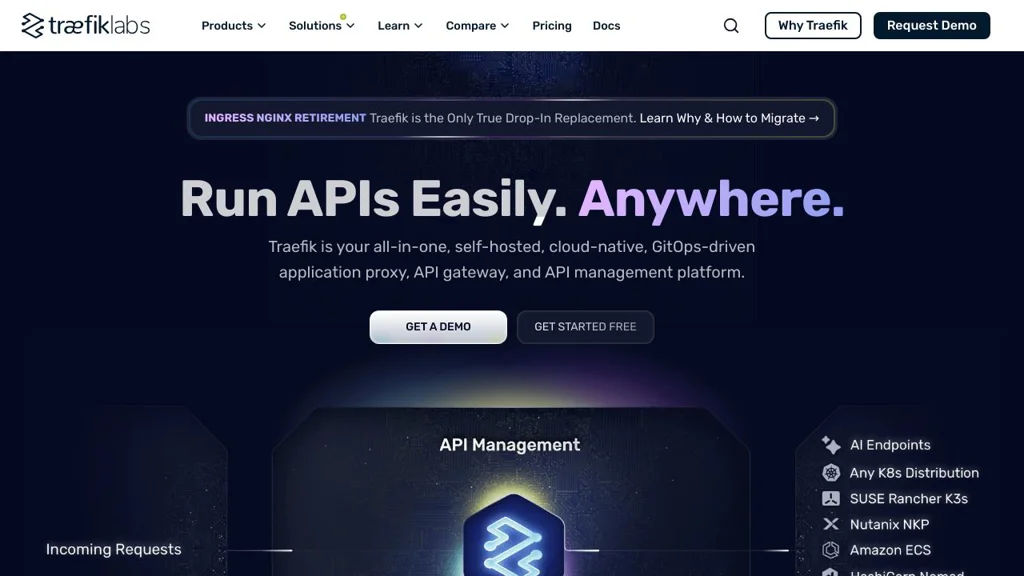
Traefik is a dynamic reverse proxy and load balancer for Docker, Kubernetes, and microservices with automatic service discovery, routing, and TLS/ACME support.

Traefik screenshot

Traefik is a cloud-native reverse proxy and load balancer designed for modern microservices and container platforms. It automatically discovers services from orchestrators and configures routing, TLS, and middlewares with minimal manual configuration.

Key Features:

  • Dynamic configuration via providers (e.g., Docker, Kubernetes, Consul, etcd, file) with automatic service discovery
  • HTTP/HTTPS routing with host/path rules, priorities, and weighted load balancing
  • Automatic TLS with ACME (e.g., Let’s Encrypt), including certificate management and renewal
  • Middleware pipeline for common edge concerns (redirects, headers, basic auth, IP allow/deny, rate limiting, retries, circuit breakers)
  • TCP and UDP routing for non-HTTP workloads
  • Integrated observability: access logs, metrics (Prometheus/others), tracing (OpenTelemetry/Jaeger/Zipkin depending on setup)
  • Traefik dashboard/API for inspecting routers, services, middlewares, and health
  • Canary/blue-green style rollouts via traffic splitting and weights

Use Cases:

  • Ingress/controller for Kubernetes clusters to expose services securely with automated TLS
  • Reverse proxy for Docker Compose homelabs to route multiple apps by hostname
  • Edge gateway for microservices needing centralized routing, auth/headers, and rate limiting

Limitations and Considerations:

  • Several advanced capabilities (e.g., richer policy/governance, enterprise-grade features) are offered in Traefik’s commercial products rather than the core proxy

Traefik is widely adopted as a default edge component for containerized environments, reducing manual proxy configuration through provider-driven discovery. It fits particularly well where services are frequently added/removed and TLS and routing rules need to be managed declaratively.

61kstars
5.8kforks
#3
Nginx Proxy Manager

Nginx Proxy Manager

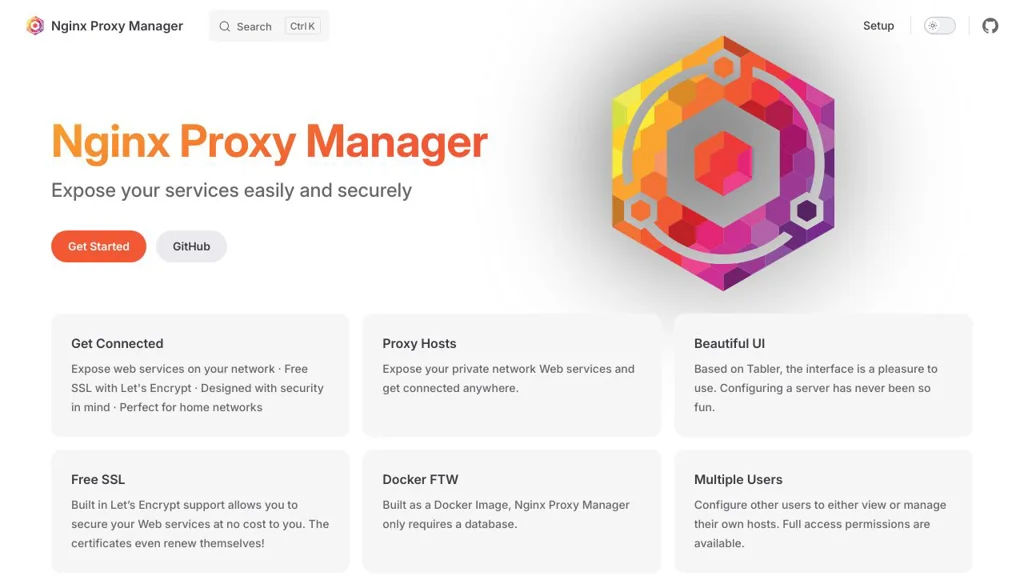
Web-based reverse proxy manager for Nginx with hosts, streams, access lists, and automatic Let's Encrypt certificates via an easy admin UI.

Nginx Proxy Manager screenshot

Nginx Proxy Manager (NPM) is a web-based management interface for configuring Nginx as a reverse proxy. It simplifies publishing internal web apps to the internet or to private networks by providing a UI to create proxy hosts, manage TLS certificates, and apply common security and routing settings without hand-editing Nginx config files.

Key Features

  • Manage Proxy Hosts (reverse proxy) with per-host settings (forward host/port, WebSocket support, caching, header tweaks)
  • Built-in Let’s Encrypt certificate issuance and renewals (including wildcard support via DNS challenge in supported setups)
  • Central certificate management: upload/import custom certificates and reuse across hosts
  • Access Lists for basic HTTP authentication and IP-based allow/deny rules
  • Support for Redirection Hosts (HTTP redirects) and 404 hosts (catch-all behavior)
  • Stream (TCP/UDP) proxying for non-HTTP services
  • Multi-user admin UI with permissions suitable for delegating proxy management
  • Runs well in containers; commonly deployed via Docker/Docker Compose

Use Cases

  • Put multiple self-hosted apps behind a single domain with HTTPS and per-app routing
  • Provide TLS termination and simple authentication in front of internal services
  • Publish TCP/UDP services (e.g., game servers or databases) through a managed stream proxy

Limitations and Considerations

  • Designed as a management layer over Nginx; complex Nginx behaviors may still require custom configuration patterns outside the UI.

NPM is a practical choice when you want the reliability of Nginx with a straightforward web UI for day-to-day proxy, TLS, and access-control operations. It is widely used in homelab and small-team environments to standardize how services are exposed and secured.

30.9kstars
3.5kforks
#4
HAProxy

HAProxy

HAProxy is a fast, reliable load balancer and reverse proxy for TCP/HTTP(S), with TLS termination, health checks, advanced routing, and built-in observability features.

HAProxy screenshot

HAProxy is a high-performance, event-driven load balancer and reverse proxy commonly used to front web applications and APIs. It provides Layer 4 (TCP) and Layer 7 (HTTP) traffic management with strong reliability, detailed control over routing, and production-grade operational tooling.

Key Features

  • Layer 4 (TCP) and Layer 7 (HTTP) load balancing with multiple algorithms (e.g., round-robin, leastconn, hashing)
  • Reverse proxy with advanced HTTP routing rules (ACLs, header/path-based routing, rewrites)
  • Health checks (active/passive) with automatic failover and server draining
  • TLS termination and SNI-based routing; certificate loading and TLS policy controls
  • High availability patterns (multi-process/threading, seamless reloads, connection draining)
  • Session persistence (stickiness) using cookies, source IP, or other keys
  • Rate limiting, request/connection shaping, and basic DDoS/abuse mitigation primitives
  • Built-in stats and administrative interface (stats page/CLI socket) plus Prometheus-style metrics support (via exporters/integrations)

Use Cases

  • Fronting websites/APIs with HTTPS termination and path/host-based routing to multiple backends
  • Highly available load balancing for microservices and internal TCP services (databases, message brokers)
  • Edge proxy for gradual rollouts (canary), maintenance windows (draining), and traffic shaping

Limitations and Considerations

  • Configuration is powerful but can be complex; many features are expressed via ACL/rules that require careful testing.
  • Some advanced capabilities may require using HAProxy Enterprise add-ons in commercial contexts (depending on desired support/features).

HAProxy is widely deployed at scale due to its performance, stability, and deep traffic-control features. It fits well where you need fine-grained routing, reliable failover, and predictable behavior under heavy load, while remaining flexible enough for diverse TCP and HTTP workloads.

6.2kstars
893forks
#5
Zoraxy

Zoraxy

Self-hosted reverse proxy and HTTP(S) gateway with a web UI, TLS support, routing rules, and traffic/security utilities for homelabs and small servers.

Zoraxy screenshot

Zoraxy is a lightweight reverse proxy designed for self-hosters who want a simple web UI to publish multiple services behind one HTTP(S) entrypoint. It focuses on easy setup, practical routing features, and built-in utilities commonly needed in homelabs and small deployments.

Key Features

  • Web-based admin UI to manage proxy hosts and routing rules
  • Reverse proxy for HTTP/HTTPS services with host- and path-based routing
  • TLS/HTTPS support (certificate management options depend on deployment)
  • Access controls and request filtering features intended to reduce unwanted traffic
  • Built-in traffic/utility tools (e.g., diagnostics and convenience features surfaced in the UI)
  • Designed to be lightweight and easy to run on modest hardware

Use Cases

  • Expose multiple self-hosted apps (media, dashboards, admin panels) under different subdomains
  • Front internal services with HTTPS and centralized routing rules
  • Provide a simple GUI-managed edge gateway for a homelab or small VPS

Limitations and Considerations

  • Feature depth and ecosystem are smaller than larger proxy stacks (e.g., NGINX/Traefik) and may not cover advanced enterprise needs.

Zoraxy fits users who want a straightforward reverse proxy with a GUI and sensible defaults rather than a highly extensible edge platform. It is particularly suitable for homelabs and small deployments where simplicity and low overhead are priorities.

4.8kstars
270forks
#6
SWAG

SWAG

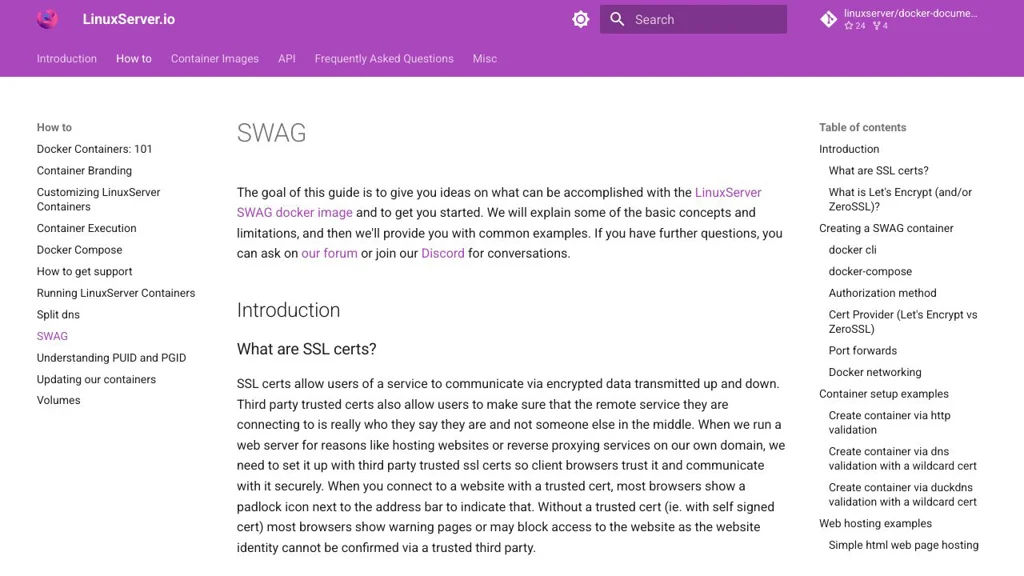
Dockerized Nginx reverse proxy with automatic Let’s Encrypt SSL, security hardening, and a large set of ready-to-use proxy configurations.

SWAG screenshot

SWAG (Secure Web Application Gateway) is a LinuxServer.io Docker image that bundles Nginx with automated TLS certificates via Let’s Encrypt. It is commonly used as a front door for multiple web apps, providing HTTPS, reverse proxying, and security-oriented defaults.

Key Features

  • Automated certificate issuance/renewal for domains and subdomains using Let’s Encrypt (Certbot)
  • Nginx reverse proxy with a large library of sample proxy configurations for common apps
  • Security-focused defaults and optional hardening snippets (headers, TLS settings, etc.)
  • Supports multiple validation methods (e.g., HTTP-01; DNS-based workflows via plugins depending on setup)
  • Optional fail2ban integration for banning abusive clients based on log patterns
  • Designed for container deployments; configuration via mounted volumes and environment variables

Use Cases

  • Put multiple self-hosted web services behind a single HTTPS endpoint with clean host-based routing
  • Quickly enable HTTPS for a homelab by reusing provided proxy templates for popular apps
  • Add a security layer (TLS, headers, basic request filtering, optional banning) in front of internal services

Limitations and Considerations

  • Nginx configuration is template/snippet-based and still requires some familiarity for custom or unusual apps
  • ACME challenges and DNS/port requirements can complicate setups behind CGNAT or restrictive networks

SWAG is a practical choice when you want an Nginx-based reverse proxy that also manages certificates automatically. Its curated proxy templates and security snippets reduce the time needed to publish and protect multiple services.

3.5kstars
280forks
#7
GoDoxy

GoDoxy

GoDoxy is a Go-based reverse proxy that routes HTTP(S) traffic to services, supports automatic TLS certificates, and offers simple configuration for self-hosted apps.

GoDoxy screenshot

GoDoxy is a lightweight reverse proxy written in Go designed to sit in front of your self-hosted services and route traffic to them reliably. It focuses on straightforward configuration, modern TLS defaults, and making it easy to expose multiple apps behind a single entrypoint.

Key Features

  • Reverse proxy for HTTP/HTTPS services with host-based routing
  • Automatic TLS certificate provisioning/renewal (ACME/Let’s Encrypt)
  • Support for multiple backends/services behind one proxy
  • Configurable upstream targets, headers, and proxy behavior
  • Designed to be small, fast, and easy to deploy (Go binary/container)

Use Cases

  • Expose multiple homelab services on separate subdomains (e.g., app1.example.com, app2.example.com)
  • Terminate TLS centrally and route to internal services on a private network
  • Replace ad-hoc per-app web server configs with a single proxy layer

GoDoxy is a practical choice when you want a minimal reverse proxy focused on routing and automated HTTPS, without the operational overhead of larger ingress stacks. It fits well in small-to-medium self-hosted setups where simplicity and predictable behavior matter.

2.7kstars
103forks

Why choose an open source alternative?

  • Data ownership: Keep your data on your own servers
  • No vendor lock-in: Freedom to switch or modify at any time
  • Cost savings: Reduce or eliminate subscription fees
  • Transparency: Audit the code and know exactly what's running