
AWS S3

Best Self Hosted Alternatives to AWS S3

A curated collection of the 5 best self hosted alternatives to AWS S3.

Amazon S3 (Simple Storage Service) is a scalable, durable object storage service for storing and retrieving any amount of data. It provides high availability, lifecycle policies, access controls, encryption, and integrations for backups, archiving, analytics, and content delivery.

Alternatives List

#1
MinIO

MinIO

Self-hosted, S3-compatible object storage server for cloud-native workloads with replication, versioning, encryption, and Kubernetes-friendly deployment.
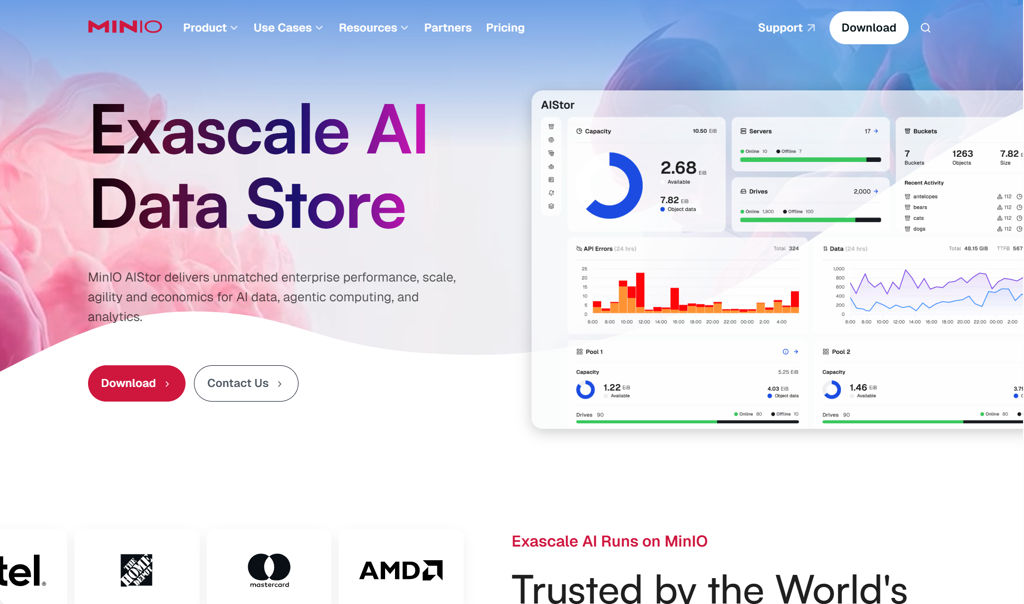
MinIO screenshot

MinIO is an open-source object storage server designed for high-performance, cloud-native and on-prem deployments. It implements an Amazon S3-compatible API, enabling applications and tools built for S3 to use MinIO as a drop-in storage backend.

Key Features

  • Amazon S3-compatible API for object storage (buckets, objects, multipart upload, presigned URLs)
  • Distributed/scale-out deployments for high availability and performance
  • Erasure coding for data protection and efficient storage utilization
  • Bucket and object versioning support
  • Replication capabilities (commonly used for site-to-site and disaster recovery scenarios)
  • Server-side encryption support (SSE) and TLS for in-transit protection
  • Identity and access management features such as policies and access keys
  • Event notifications/hooks for integrating with external systems (e.g., message queues/webhooks)

Use Cases

  • Private S3-compatible storage for applications, backups, and archives
  • Storage layer for Kubernetes and cloud-native platforms needing S3 APIs
  • Log, media, and dataset storage for analytics/ML pipelines

Limitations and Considerations

  • Object storage semantics differ from POSIX filesystems; applications may require S3-native integration
  • Distributed deployments require careful planning for networking, disk layout, and operational monitoring
  • Some advanced enterprise capabilities may depend on MinIO’s broader ecosystem and deployment choices

MinIO is commonly used to replace managed object storage when organizations need full control over data location, performance tuning, and on-prem or edge deployments. Its S3 compatibility makes it suitable for integrating with a wide range of existing tools and software that already support S3.

59.6kstars
6.9kforks

#2
copyparty

copyparty

A lightweight, portable web-based file server with uploads, WebDAV, search, and optional media indexing—designed to run anywhere with minimal dependencies.

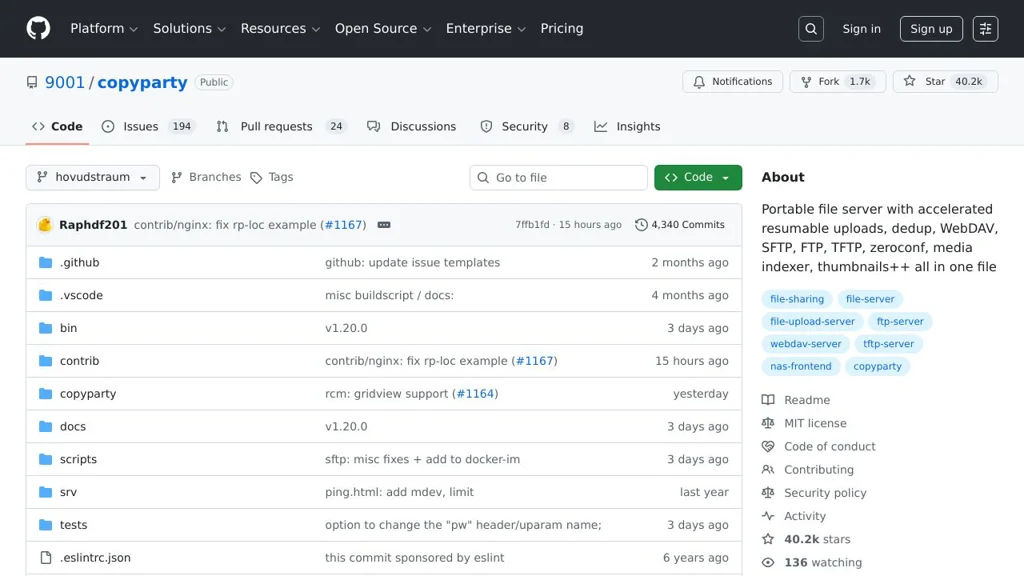
copyparty screenshot

copyparty is a lightweight, portable file server you can run from a single folder to share, browse, and upload files over HTTP. It focuses on being easy to deploy while still offering power-user features like WebDAV, indexing, and flexible access controls.

Key Features

  • Web UI for browsing, downloading, and uploading files (including drag-and-drop)
  • WebDAV support for mounting as a network drive and syncing with WebDAV clients
  • Share links and directory publishing with configurable permissions
  • User authentication and per-path access control (read/write/admin-style rules)
  • Optional indexing for faster browsing/search and media-oriented views (e.g., galleries)
  • Single-binary / single-folder style deployment with cross-platform support
  • Command-line configuration with extensive runtime options (ports, bind, users, perms)

Use Cases

  • Quickly share files on a LAN/Wi‑Fi network without setting up a full NAS stack
  • Provide a WebDAV endpoint for lightweight file access from desktops/mobile clients
  • Host a simple personal file drop/upload area for a team, event, or temporary project

Limitations and Considerations

  • Feature set is optimized for lightweight file serving; it is not a full sync platform like Dropbox/Drive.
  • Some advanced capabilities (indexing/media features) may require extra configuration depending on usage.

copyparty is a good fit when you want a small, fast file server that can be started quickly and still supports structured access control and WebDAV. It’s commonly used for ad-hoc sharing, home-lab file serving, and lightweight team file drop scenarios.

40.4kstars
1.7kforks
#3
Cloudreve

Cloudreve

Cloudreve is a self-hosted cloud storage and file sharing platform with a web UI, multi-user management, and support for local, S3, and other storage backends.

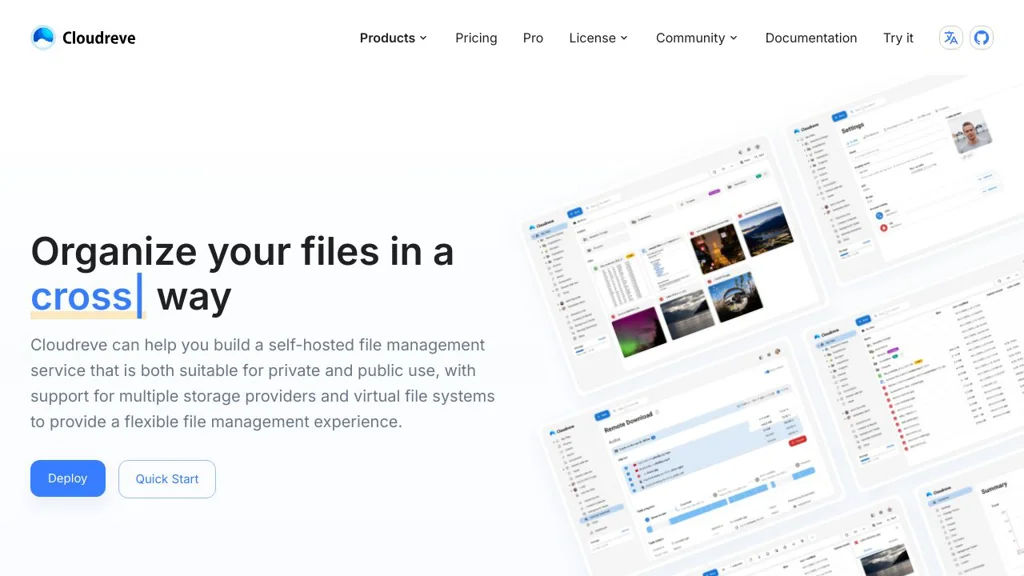
Cloudreve screenshot

Cloudreve is a self-hosted cloud storage and file management platform that provides a web-based drive experience for individuals and teams. It focuses on flexible storage backends, user/group management, and link-based sharing so you can run a “personal cloud” on your own infrastructure.

Key Features

  • Web-based file manager with uploads/downloads, folder browsing, and search
  • Multi-user support with user/group management and permission controls
  • Link sharing for files/folders (commonly including expiration and access control options)
  • Multiple storage backends (commonly including local storage and S3-compatible object storage)
  • WebDAV support for mounting the storage as a network drive in desktop/mobile clients
  • Admin dashboard for configuration, storage policies, and basic system management
  • Extensible deployment options (commonly distributed as a single binary and via containers)

Use Cases

  • Replace hosted personal cloud drives for private file storage and sharing
  • Team file drop/share portal with controlled access and expiring links
  • Front-end gateway that unifies multiple storage backends under one web UI

Limitations and Considerations

  • Some advanced collaboration features (real-time co-editing) generally require external office suites/integrations rather than being built-in

Cloudreve is a practical choice when you want a modern “cloud drive” experience with strong storage-backend flexibility and standard access methods like WebDAV. It fits both personal and small-team deployments where file sharing and centralized management are the primary needs.

26.5kstars
3.8kforks
#4
SFTPGo

SFTPGo

Self-hosted SFTP/FTP/WebDAV server with web admin, virtual users, storage backends, and auditing for secure file exchange and managed file transfer workflows.

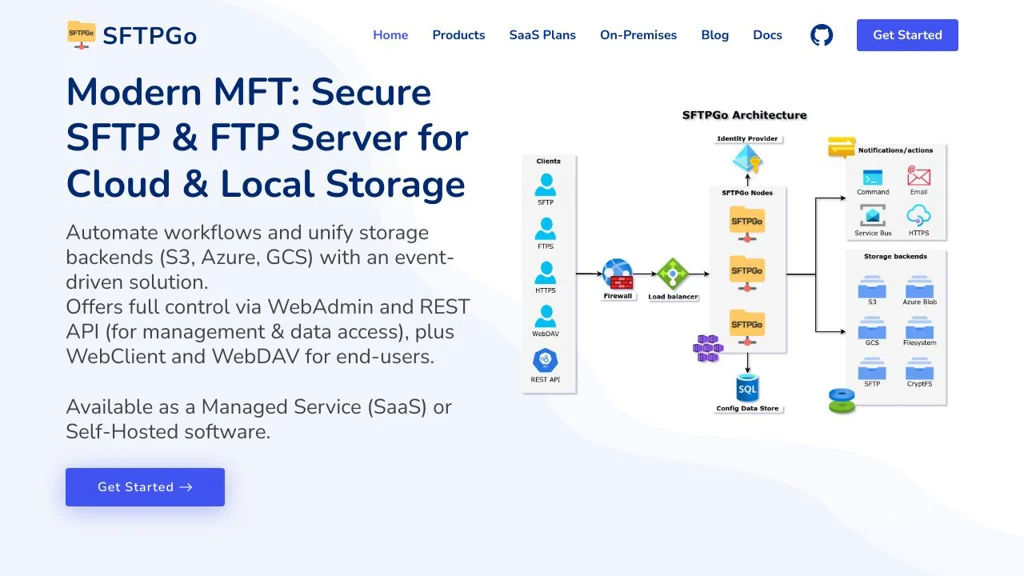
SFTPGo screenshot

SFTPGo is a configurable file transfer server focused on secure managed file transfer for teams and applications. It provides virtual users, fine-grained permissions, and multiple supported protocols so you can expose a controlled file exchange endpoint without giving shell access.

Key Features

  • Supports multiple protocols: SFTP, FTP/S (FTPS), WebDAV, and HTTP/S file sharing endpoints
  • Web-based administration UI plus a REST API for automation and provisioning
  • Virtual users with per-user home directories, quotas, bandwidth limits, and granular permissions
  • Pluggable storage backends (local filesystem and cloud/object storage backends supported by the project)
  • Key-based and password authentication; SSH host keys and TLS configuration for secure transport
  • Auditing/visibility features such as logs and user activity tracking for compliance needs
  • Event-driven extensibility (hooks/notifications) for integrating with external systems and workflows

Use Cases

  • Provide a managed SFTP/FTPS dropbox for partners/vendors with per-user permissions and quotas
  • Replace ad-hoc file exchange (shared SMB folders or personal cloud drives) with audited transfers
  • Offer automated file ingress/egress for applications via REST API provisioning and scripted clients

Limitations and Considerations

  • Not a general-purpose sync client/server; it is oriented to file transfer and controlled sharing rather than real-time collaboration

SFTPGo is well-suited for organizations that need standards-based file transfer (SFTP/FTPS/WebDAV) with centralized user management and automation. It combines a straightforward deployment with administrative controls commonly needed for managed file transfer scenarios.

11.6kstars
891forks
#5
Zot

Zot

Zot is an OCI-compliant container registry for storing, signing, and distributing container images and OCI artifacts with a web UI, API, and multiple storage backends.

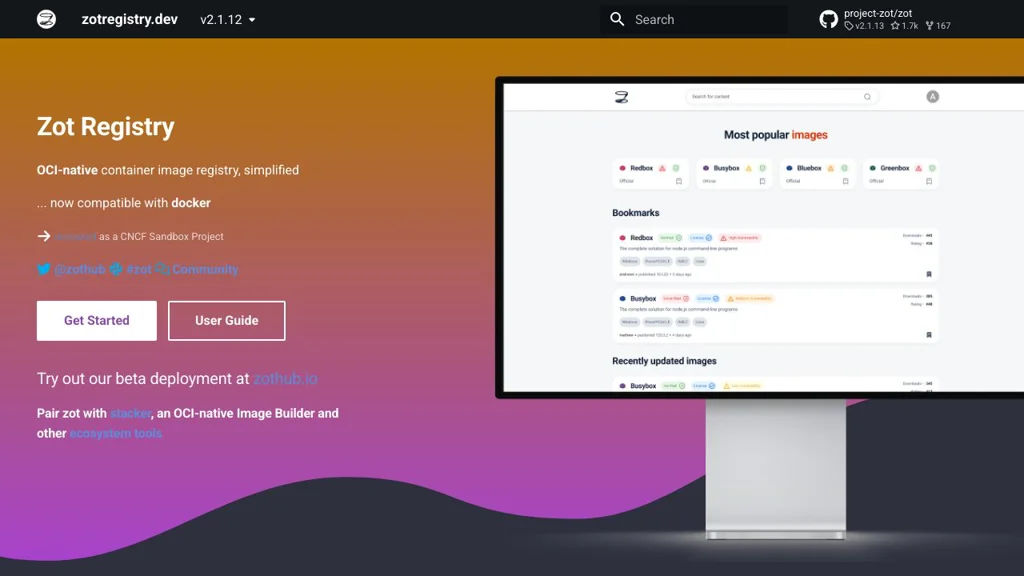
Zot screenshot

Zot is an OCI-native registry server for storing and distributing container images and other OCI artifacts. It focuses on standards compliance (OCI Distribution/Artifacts) and provides both a registry API and a built-in web UI for browsing repositories, tags, and manifests.

Key Features

  • Implements the OCI Distribution Specification for pushing/pulling images and artifacts
  • Web UI for browsing repositories, tags, manifests, and image details
  • Supports OCI artifacts beyond images (artifact-centric registry usage)
  • Pluggable storage backends (filesystem and cloud/object backends depending on configuration)
  • AuthN/AuthZ options via configuration (e.g., basic auth and other modes as supported)
  • Image signing and verification workflows via OCI artifact/signature integrations (where configured)

Use Cases

  • Private container registry for Kubernetes/CI pipelines to host images internally
  • Hosting and distributing OCI artifacts (e.g., signatures/SBOM-style artifacts) alongside images
  • Edge/air-gapped environments needing a lightweight registry with a simple UI

Limitations and Considerations

  • Feature depth varies by configuration and enabled extensions; some enterprise registry conveniences (advanced replication/policy engines) may require additional tooling

Zot is suited for teams that want a standards-first OCI registry with a straightforward deployment model and optional UI, while keeping compatibility with common container tooling. It is commonly considered when you need an OCI registry that can also serve as a general OCI artifact store.

1.7kstars
167forks

Why choose an open source alternative?

  • Data ownership: Keep your data on your own servers
  • No vendor lock-in: Freedom to switch or modify at any time
  • Cost savings: Reduce or eliminate subscription fees
  • Transparency: Audit the code and know exactly what's running