
CloudApp

Best Self Hosted Alternatives to CloudApp

A curated collection of the 15 best self hosted alternatives to CloudApp.

CloudApp is a visual communication SaaS that lets teams capture and share screenshots, GIFs, and screen recordings with annotations and instant links to speed feedback, support, and collaboration.

Alternatives List

#1
Asciinema

Asciinema

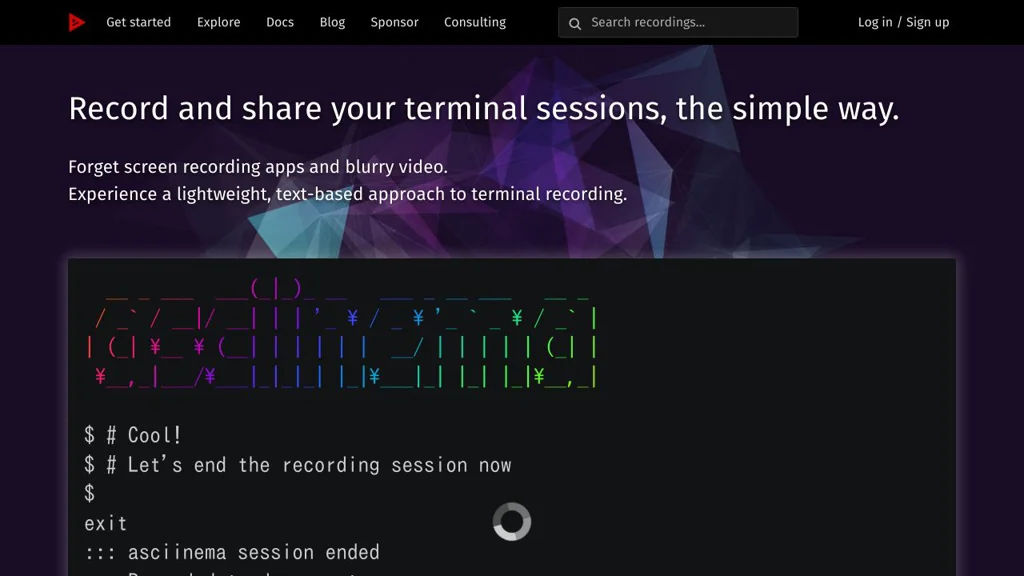
CLI tool and web app to record, replay, and share terminal sessions in a compact, text-based format with copyable output and embeddable players.
Asciinema screenshot

Asciinema is a terminal session recorder and player that captures what happens in your shell and replays it as a text-based “asciicast”. It is commonly used to share CLI demos, tutorials, and bug reproductions with accurate timing and copyable output.

Key Features

  • Records terminal input/output with timing data (not a video), producing small .cast files
  • Local playback in the terminal via asciinema play
  • Web playback via an embeddable HTML player (asciinema player)
  • Upload/sharing workflow using asciinema upload and the asciinema.org hosting service (optional)
  • Copyable terminal text during playback (useful for commands/snippets)
  • JSON-based cast format that can be post-processed and integrated into toolchains
  • Supports theming and terminal size metadata for consistent replays

Use Cases

  • Create CLI demos for README files, documentation portals, and blog posts
  • Share reproducible bug reports or support requests with exact terminal timing
  • Produce training materials for internal tooling and onboarding

Limitations and Considerations

  • Captures terminal I/O, not pixels: full-screen TUIs may replay differently across environments
  • Not suitable for demos requiring rich visuals (images/video); use screen recording for that

Asciinema provides a practical middle ground between static snippets and heavyweight video recordings, enabling accurate, lightweight, and script-friendly sharing of terminal sessions. It fits well into developer documentation and teaching workflows where copyable output and small artifacts matter.

16.6kstars
992forks

#2
ownCloud

ownCloud

Self-hosted file sync and sharing platform with web/mobile/desktop clients, WebDAV access, sharing controls, versioning, and enterprise-grade security and auditing.

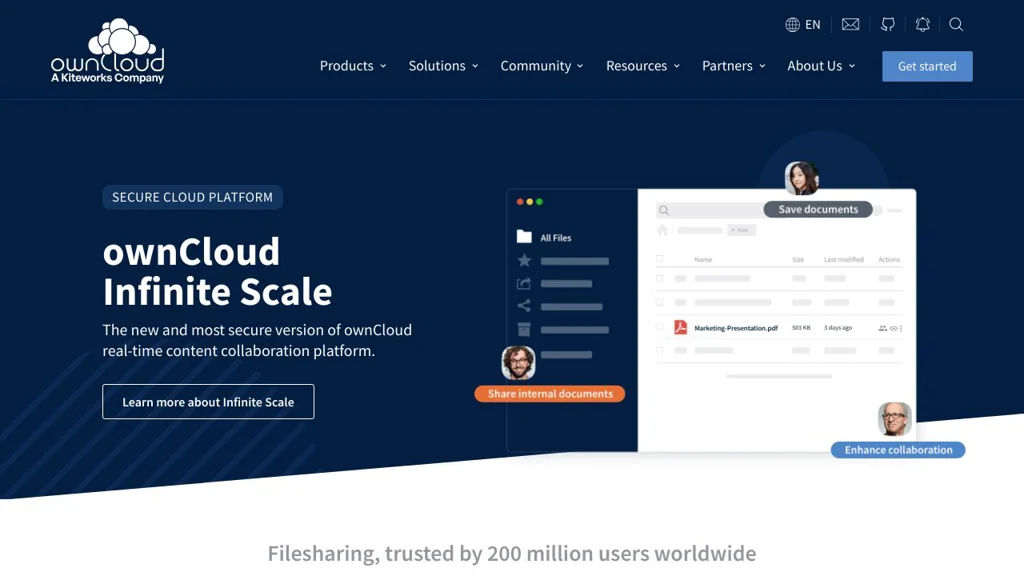
ownCloud screenshot

ownCloud is a file sync and sharing (EFSS) server for hosting private cloud storage on your own infrastructure. It provides web, desktop, and mobile access to files, plus secure sharing and collaboration features aimed at organizations that need control, compliance, and extensibility.

Key Features

  • Web interface plus desktop and mobile sync clients for accessing and syncing files
  • WebDAV support for standards-based file access and mounting as a network drive
  • File sharing with link sharing, password protection and expiration (configurable policies)
  • Versioning and recycle bin/trash to recover previous versions and deleted files
  • User and group management with role-based administration and storage quotas
  • External storage backends (e.g., S3-compatible/object storage, SMB/CIFS, FTP) via storage apps
  • Activity stream, notifications, and auditing capabilities (feature set depends on edition/apps)
  • App/plugin ecosystem to extend functionality (e.g., collaboration, storage, auth, integrations)

Use Cases

  • Internal “private Dropbox/OneDrive” for organizations needing data residency and policy control
  • Secure partner/customer file delivery with expiring, password-protected share links
  • Central file access layer over mixed backends (local storage, SMB shares, object storage)

Limitations and Considerations

  • Some advanced enterprise capabilities (governance, compliance features, certain integrations) may require paid enterprise components/support depending on deployment and edition
  • Scaling and performance depend heavily on backend storage, caching, and database tuning; production setups typically require careful ops planning

ownCloud is a mature EFSS platform suited to teams that want a standards-based file platform (notably WebDAV) with flexible storage backends and administrative controls. It fits best where extensibility, policy enforcement, and infrastructure control are primary requirements.

8.7kstars
2.1kforks
#3
PrivateBin

PrivateBin

Self-hosted, zero-knowledge pastebin that encrypts text in the browser, supports file attachments, expiration, burn-after-reading, and discussion threads.

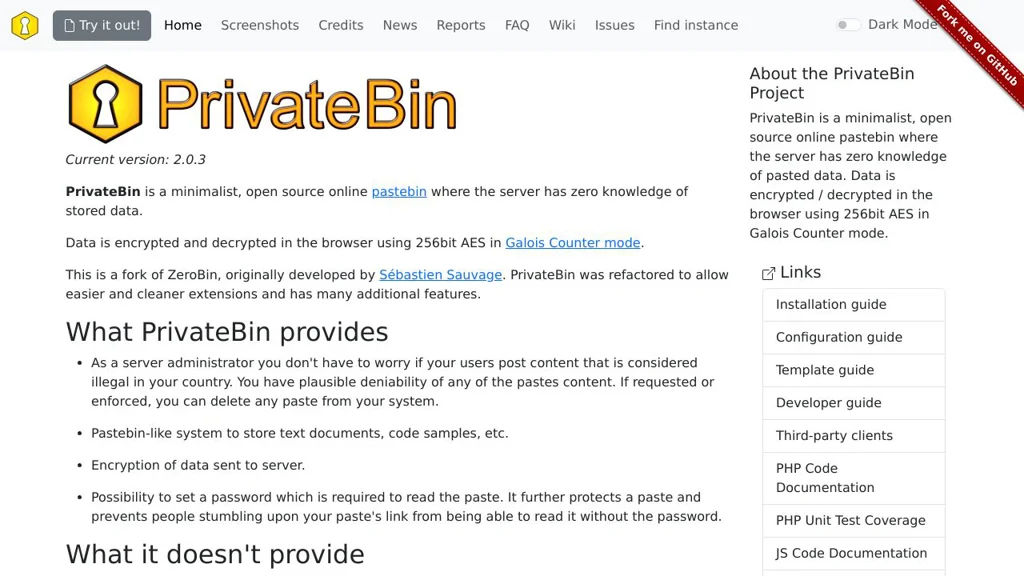
PrivateBin screenshot

PrivateBin is a minimalist pastebin designed for privacy: paste content is encrypted and decrypted in the browser so the server cannot read it (“zero knowledge”). It supports sharing sensitive text (and optional attachments) via a link, with controls for expiration and one-time reading.

Key Features

  • Client-side end-to-end encryption (server stores only ciphertext)
  • Optional password protection (in addition to E2EE)
  • Expiration settings for pastes (time-based)
  • “Burn after reading” / one-time view option
  • Discussion mode with threaded comments on a paste
  • Syntax highlighting for many languages
  • File attachments (stored encrypted alongside the paste)
  • Optional formatter support (e.g., Markdown) and configurable templates/themes
  • No user accounts required; designed for simple, anonymous sharing

Use Cases

  • Share secrets or configuration snippets with a team using expiring links
  • Send one-time incident notes or credentials via “burn after reading”
  • Publish encrypted snippets for support/debugging without exposing plaintext on the server

Limitations and Considerations

  • If the decryption key embedded in the URL is leaked (e.g., via referrer logs or chat previews), confidentiality is lost; deployments should consider referrer policy and HTTPS.

PrivateBin is well-suited for organizations and individuals who want a lightweight, auditable paste service where the host cannot access paste contents. Its focus on client-side encryption and practical sharing controls makes it a common replacement for hosted paste and “secure note” services.

7.9kstars
952forks
#4
Opengist

Opengist

Opengist is a self-hosted, Git-backed alternative to GitHub Gist for sharing code snippets and text pastes with syntax highlighting, Markdown support, and user management.

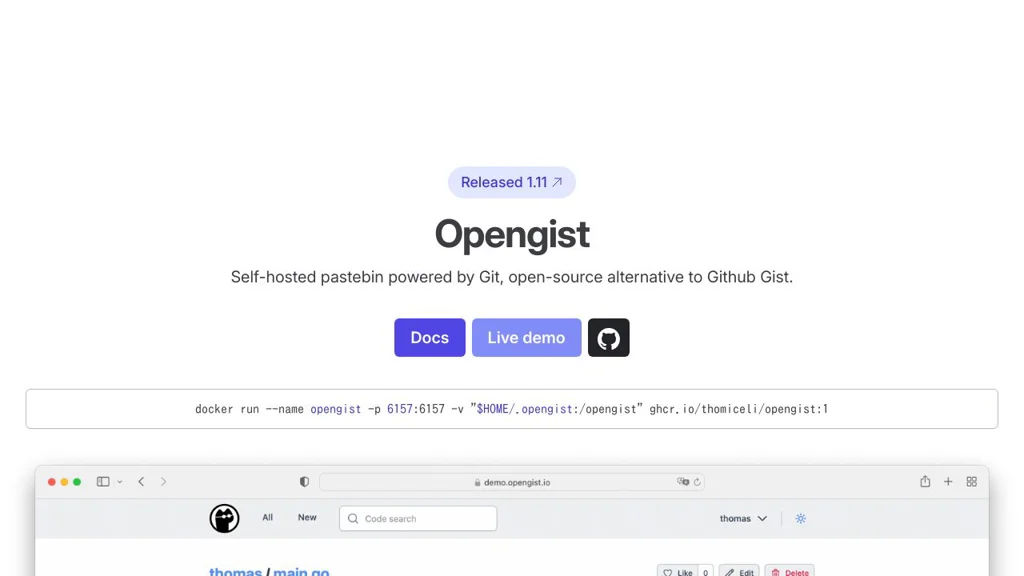
Opengist screenshot

Opengist is a lightweight, self-hosted gist service for publishing and collaborating on code snippets and text pastes. It is designed as an alternative to GitHub Gist, with content stored in Git repositories for versioning and portability.

Key Features

  • Git-backed storage for gists (history/versioning via commits)
  • Public and private gists with sharing links
  • Syntax highlighting for many languages
  • Markdown rendering for README-style snippets
  • Revisions and diff/history browsing
  • User accounts with administration capabilities
  • Import/migration support from GitHub Gist (via tooling/workflows provided by the project)
  • HTTP(S) deployment support with reverse proxies (common Docker-based deployment patterns)

Use Cases

  • Internal “team gist” for reusable snippets, runbooks, and config examples
  • Personal pastebin for sharing logs, commands, and short notes
  • Lightweight snippet hosting for projects that don’t want full Git forge overhead

Limitations and Considerations

  • Focused specifically on gists/snippets; it is not a full Git hosting platform (no full PR/issue workflows)

Opengist fits teams and individuals who want gist-like sharing with Git-native versioning, simple governance, and easy portability. It is especially useful when you need a minimal snippet service that stays under your control while remaining compatible with common Git-based workflows.

2.9kstars
143forks
#5
FileGator

FileGator

FileGator is a PHP-based web file manager for uploading, downloading, previewing, and managing files via a browser with multi-user auth and configurable storage backends.

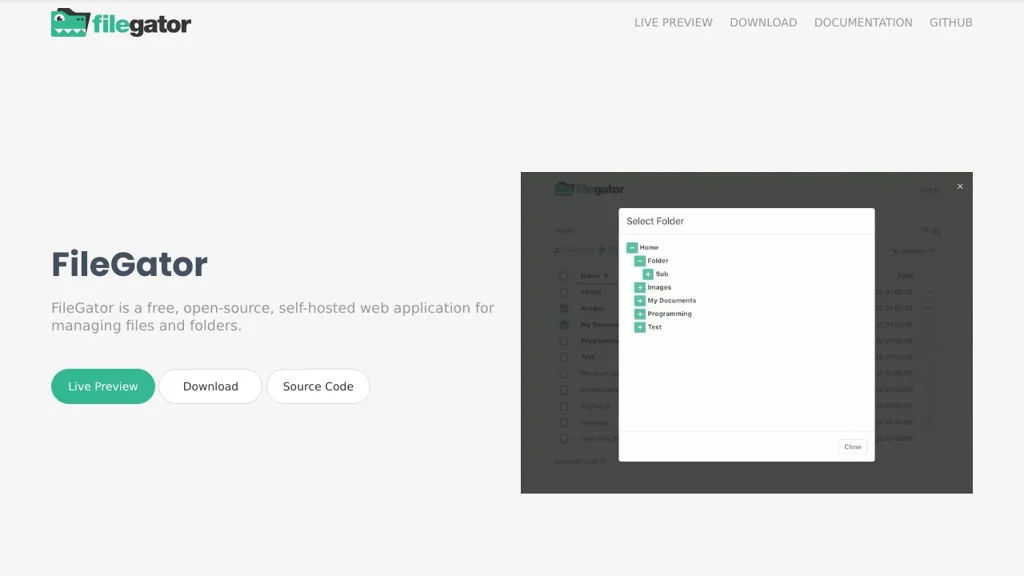
FileGator screenshot

FileGator is a self-contained web application that provides a browser-based file manager for uploading, downloading, organizing, and previewing files on a server. It is designed as a lightweight alternative to full sync-and-share platforms, focusing on easy deployment and a familiar file-explorer UI.

Key Features

  • Web-based file manager: browse, create folders, rename, move/copy, delete, and search
  • Upload/download with drag-and-drop UI and bulk operations
  • File preview for common formats (e.g., images, text) directly in the browser
  • User authentication with role/permission configuration (deployments can restrict access)
  • Pluggable storage layer (local filesystem and additional adapters depending on configuration)
  • Internationalization support and configurable UI options
  • API/extension points for integrating FileGator into other workflows (via its internal architecture)

Use Cases

  • Provide a simple “upload portal” for teams/clients to exchange files via a browser
  • Manage files on a server/NAS from any device without SSH/SFTP
  • Offer a lightweight web file browser for internal tools, kiosks, or lab environments

Limitations and Considerations

  • Not a full sync-and-share platform (no desktop sync client; collaboration features are limited compared to suites like Dropbox)

FileGator fits best when you need a straightforward, browser-based file manager with uploads, previews, and access control, without the operational overhead of a full document collaboration stack. It’s commonly used as a simple web UI on top of server storage for internal sharing and administration.

2.9kstars
434forks
#6
Zipline

Zipline

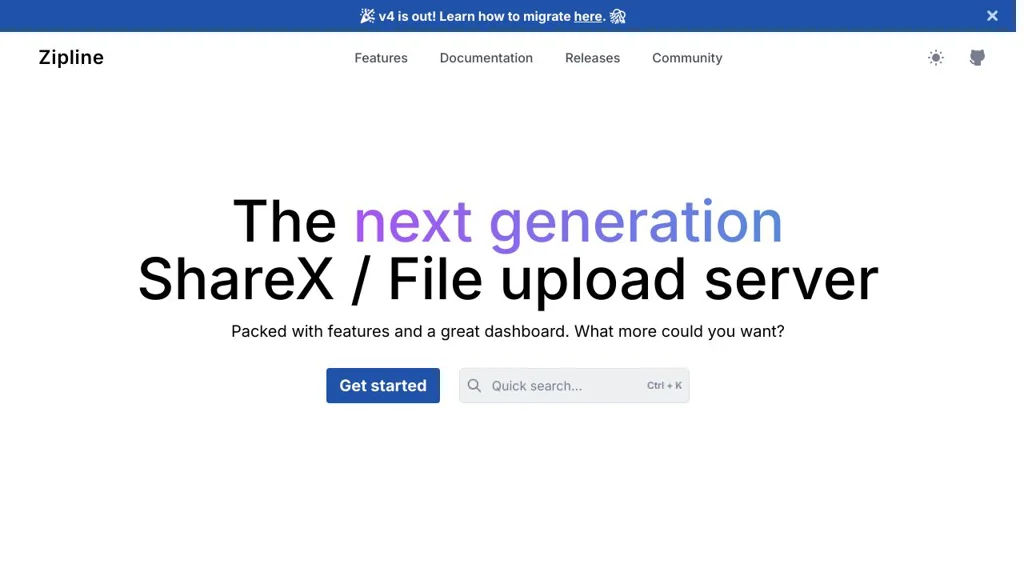
Zipline is a self-hosted file uploader and share service with image handling, URL shortening, and S3-compatible storage support for fast, simple sharing.

Zipline screenshot

Zipline is a self-hosted file upload and sharing service designed for quickly uploading files (especially images) and sharing them via clean links. It provides an admin UI and API-focused workflow, with configurable storage backends and link utilities so you can run a lightweight “ShareX-like” server.

Key Features

  • Web UI for uploads and administration, plus an HTTP API for programmatic/CLI clients
  • URL shortening with redirect management alongside file hosting
  • Supports local disk and S3-compatible object storage backends
  • Direct links and share pages optimized for quick sharing (including images)
  • User/auth management and configurable application settings for controlled access

Use Cases

  • Personal or team “ShareX target” for fast screenshot/image uploads and share links
  • Host and share small files internally with simple URLs
  • Run a private URL shortener for homelab/teams alongside file uploads

Limitations and Considerations

  • Not intended to be a full sync-and-collaboration suite (e.g., drive-style document editing)

Zipline fits best when you want a minimal, fast upload endpoint with a clean UI and API. With object storage support and URL shortening in one service, it works well as a small, private sharing utility for individuals or teams.

2.8kstars
213forks
#7
Chibisafe

Chibisafe

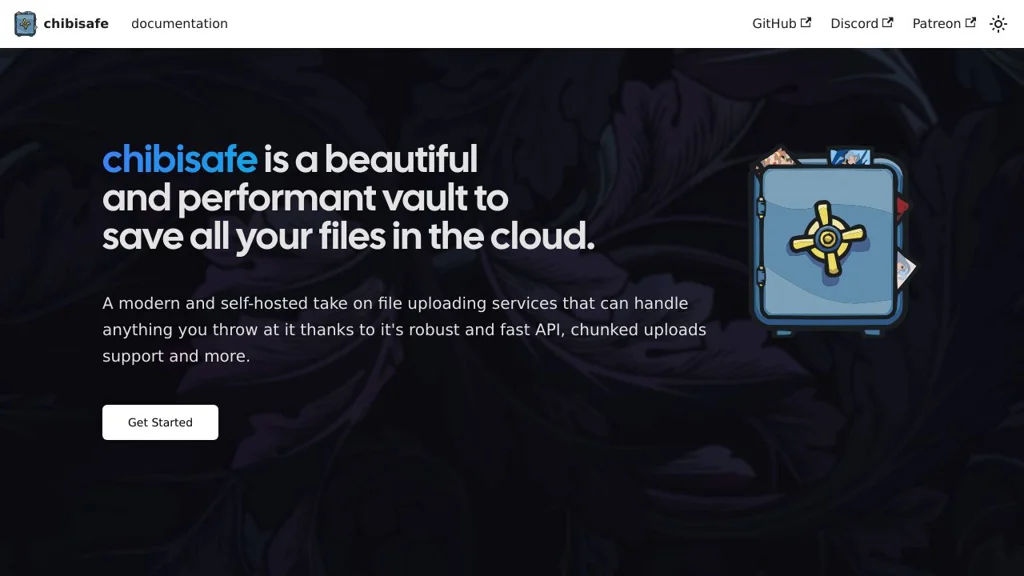
Self-hosted file and image sharing with albums, expiring links, and an API—built for quick uploads and easy sharing.

Chibisafe screenshot

Chibisafe is a self-hosted file sharing service focused on quickly uploading and sharing images and other files via a clean web UI and a developer-friendly API. It is commonly used as a lightweight alternative to hosted image/file hosts, with support for direct links and shareable pages.

Key Features

  • Web UI for uploading and managing files
  • Direct file links and share pages for easy sharing
  • Album/gallery organization for grouping uploads
  • Configurable retention options such as expiring links (where supported by configuration)
  • Public API intended for integrations and automation (e.g., upload from scripts)
  • Docker-based deployment for straightforward installation and updates

Use Cases

  • Personal or team image hosting for sharing screenshots and media
  • Private file drop for sharing files via links without relying on third-party hosts
  • Backend for automated uploads from scripts or tools using the API

Limitations and Considerations

  • Primarily focused on lightweight sharing/hosting; it is not a full document management system (advanced workflows, rich permissions, etc.)

Chibisafe fits users who want a simple, fast, link-based sharing workflow with the option to integrate uploads into tooling via an API. It is a practical choice for personal servers, small teams, and homelabs that need predictable control over uploaded content.

2.5kstars
299forks
#8
Gokapi

Gokapi

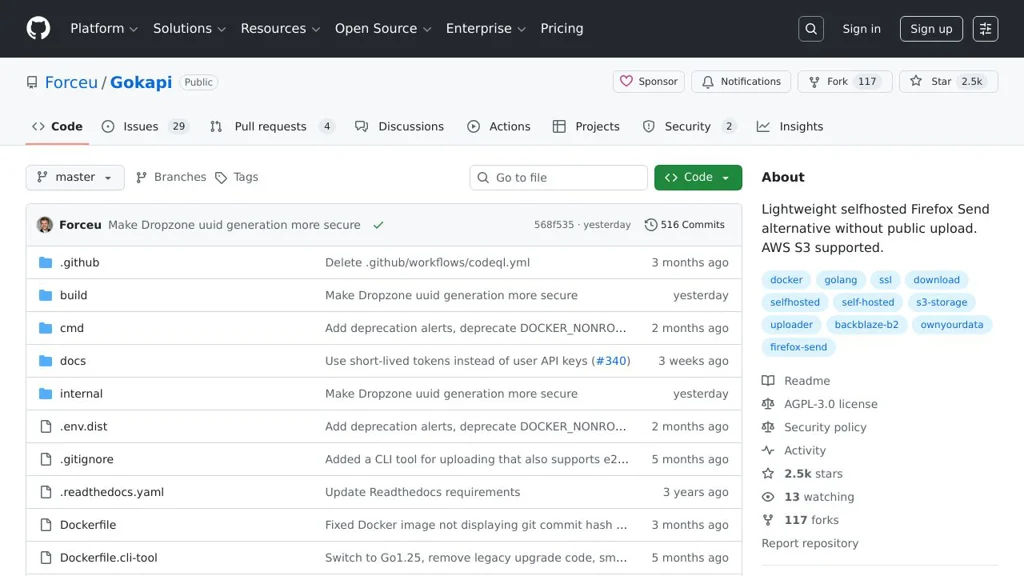
Gokapi is a lightweight file-sharing server that provides expiring links, download statistics, and an admin UI for managing uploads and retention policies.

Gokapi screenshot

Gokapi is a lightweight web application for securely sharing files via links. It focuses on simple uploads, configurable retention, and visibility into how shared files are being accessed, making it suitable for personal and small-team “send a file” workflows.

Key Features

  • Web UI for uploading files and generating shareable download links
  • Expiration and retention controls (time-based validity and automatic cleanup)
  • Download tracking and basic statistics (e.g., number of downloads)
  • Optional password protection for shared files/links
  • Admin interface for managing uploads, users/settings, and storage behavior
  • Works well behind a reverse proxy and supports custom domain setups

Use Cases

  • Replace ad-hoc transfers via public services for sending large files to clients
  • Share one-off downloads inside a team with expirations and simple tracking
  • Provide temporary download links for build artifacts or documents

Limitations and Considerations

  • Designed for straightforward file sharing rather than full sync/collaboration (not a Dropbox-style platform)
  • Feature scope is intentionally minimal; advanced enterprise governance/workflows are out of scope

Gokapi aims to be easy to deploy and operate while still providing the essentials—expiring links, optional access controls, and visibility into downloads. If you need a small, focused file-sharing service with an admin UI and retention controls, it fits well.

2.5kstars
117forks
#9
ByteStash

ByteStash

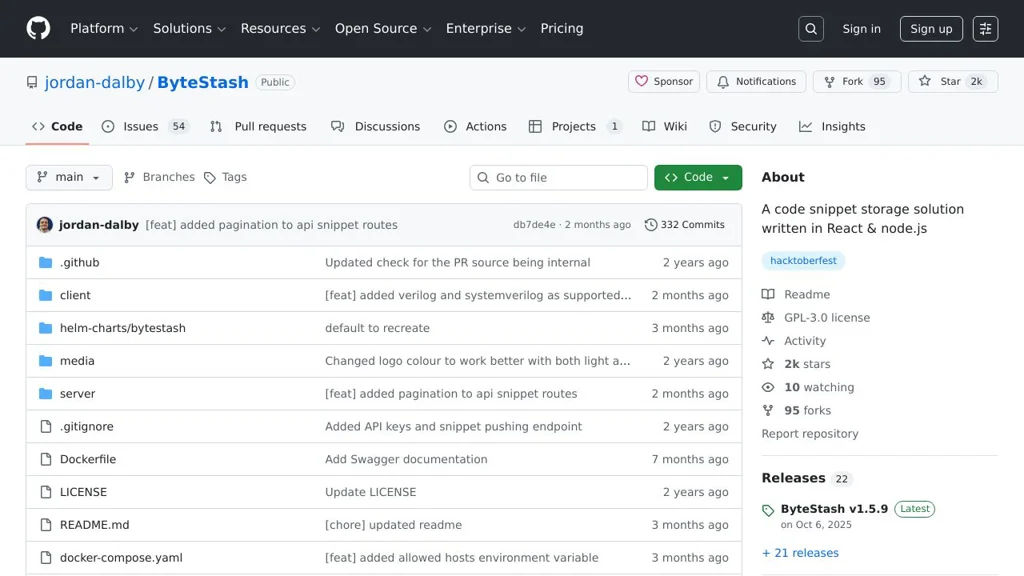
ByteStash is a self-hosted code snippet manager for saving, organizing, and searching snippets with tags, syntax highlighting, and a clean web interface.

ByteStash screenshot

ByteStash is a self-hosted web application for storing and organizing code snippets (and small notes) in one place. It focuses on a fast, simple UI for capturing snippets, tagging them, and finding them later.

Key Features

  • Create, edit, and browse a personal snippet library from a web UI
  • Tagging and organization features for grouping related snippets
  • Syntax highlighting for many common programming languages
  • Search and filtering to quickly find saved snippets
  • Docker-based deployment for straightforward installation/updates

Use Cases

  • Maintain a personal “code cookbook” of reusable functions and configs
  • Share a small internal snippet library within a team/network
  • Store operational runbooks: commands, one-liners, and configuration blocks

ByteStash is a lightweight choice for developers who want a simple, self-managed snippet repository with a modern interface and quick retrieval via tags and search.

2kstars
95forks
#10
PsiTransfer

PsiTransfer

PsiTransfer is a lightweight web app for sharing files via upload links, with optional one-time downloads, expiration, and basic access controls.

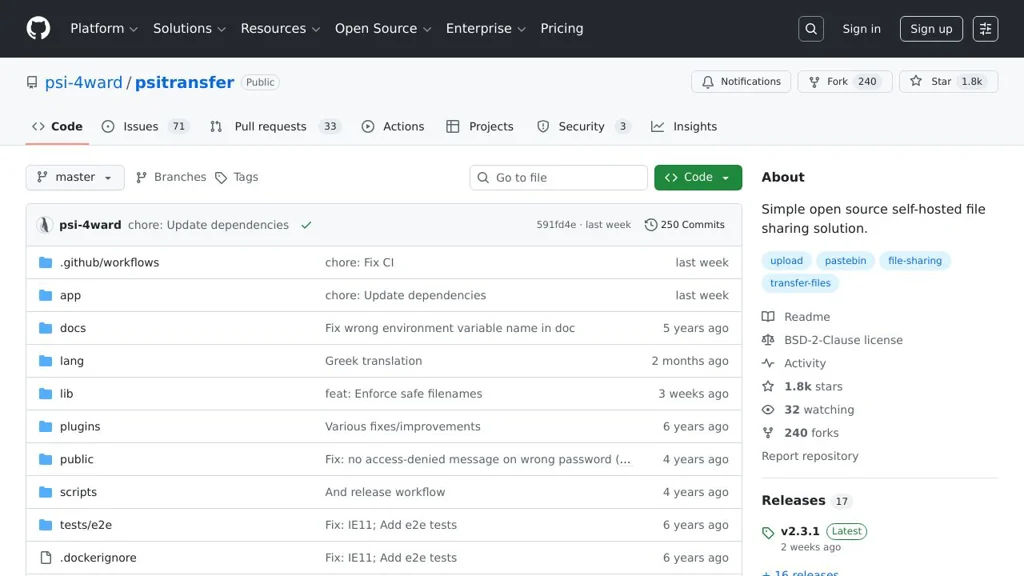
PsiTransfer screenshot

PsiTransfer is a minimal web-based file sharing application designed for quickly sending files through a browser. It provides a simple upload-and-share workflow and can be run as a small standalone service (commonly via Docker) behind your own domain.

Key Features

  • Web UI for uploading and sharing files via generated download links
  • Optional one-time downloads (burn-after-reading style)
  • Expiration options (time-based) for shared files/links
  • Basic access protection options (e.g., password-protected downloads)
  • Drag-and-drop uploads and multi-file support
  • Docker-based deployment support for easy hosting

Use Cases

  • Send large files to clients/teammates without email attachments
  • Create short-lived links for sensitive documents (e.g., invoices, exports)
  • Provide a simple “drop box” endpoint for ad-hoc file collection

Limitations and Considerations

  • Focused on simple transfer/sharing; not a full sync-and-share platform (no folders, collaboration, or rich permissions)

PsiTransfer fits teams or individuals who want a straightforward web interface for temporary file distribution without the complexity of full document management or cloud drive products. It’s best used for ad-hoc transfers where simplicity and expiring/one-time links are more important than collaboration features.

1.8kstars
240forks
#11
ProjectSend

ProjectSend

ProjectSend is a self-hosted web app for securely sharing files with clients using user accounts, groups, permissions, and optional public links with expiration.

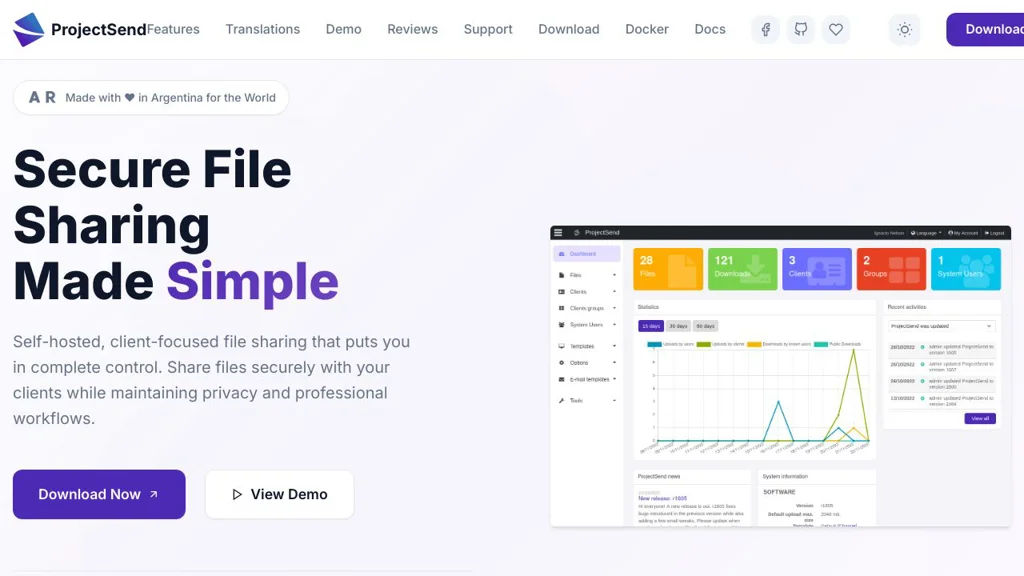
ProjectSend screenshot

ProjectSend is a web-based application for distributing files to clients and stakeholders from your own server. It focuses on controlled delivery: upload files, assign them to specific users or groups, and let recipients download from a private portal.

Key Features

  • Upload files and assign access to individual users or groups
  • Client-facing portal for browsing and downloading available files
  • Optional public links for files (with configurable availability/expiration)
  • User management with roles (admin/staff/client) and permissions
  • Groups to simplify sharing the same files with multiple recipients
  • Email notifications to users when new files are assigned (SMTP)
  • Download/activity logs for basic auditing of access and actions
  • Custom branding (logo, themes) and multi-language UI

Use Cases

  • Agencies delivering final assets and documents to clients
  • Internal teams sharing files with external contractors per project group
  • Organizations publishing files to partners via expiring public links

Limitations and Considerations

  • Not a full sync-and-collaborate platform (no real-time editing or file sync clients)
  • Requires server-side PHP/MySQL administration and ongoing security updates

ProjectSend is best suited for straightforward “send files to clients” workflows where ownership and hosting stay under your control. Its user/group permissions and link sharing make it practical for repeated client deliveries without relying on third-party file transfer services.

1.8kstars
339forks
#12
Sharry

Sharry

Sharry is a self-hosted file sharing server with upload requests, expiring links, and an optional web UI for securely exchanging files.

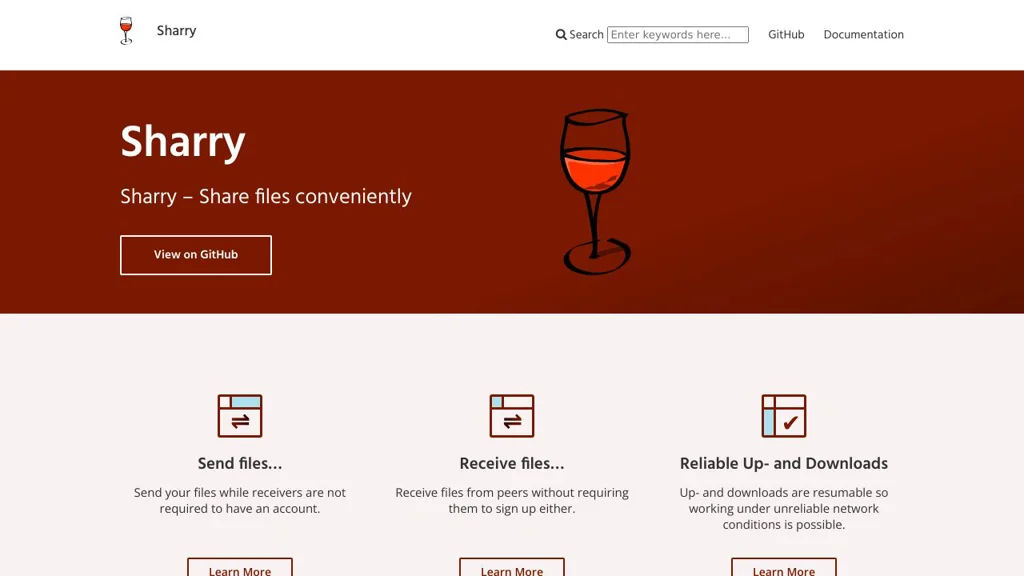
Sharry screenshot

Sharry is a self-hosted web application for securely sharing files via links and collecting files from others via “upload requests”. It is designed for lightweight, ad-hoc file exchange (send a link, set limits, receive files) while keeping control of storage and policies.

Key Features

  • Share files via generated links with configurable expiration and limits
  • Upload requests (“drop-offs”): create a link so others can upload files to you
  • Optional password protection for shares/requests
  • Configurable retention/cleanup behavior for expired items
  • Web UI plus HTTP API for automation and integration
  • Authentication options and admin configuration (deployment-dependent)

Use Cases

  • Send large files to external partners with expiring links instead of email attachments
  • Collect documents from clients/candidates through a controlled upload link
  • Internal “temporary transfer” service for teams (ad-hoc exchange without syncing)

Limitations and Considerations

  • Not a sync-and-collaboration drive (no real-time editing or folder sync)
  • Feature set is intentionally focused on sharing/collection rather than full DAM

Sharry fits organizations that need a simple, controlled alternative to public file-transfer sites, with link-based sharing, inbound upload links, and policy-driven expiry/cleanup. It can be deployed as a small internal service or integrated via its API for automated workflows.

1.2kstars
68forks
#13
xBackBone

xBackBone

xBackBone is a self-hosted web app for uploading files and screenshots, organizing them, and sharing them via direct links with optional expiration and access controls.

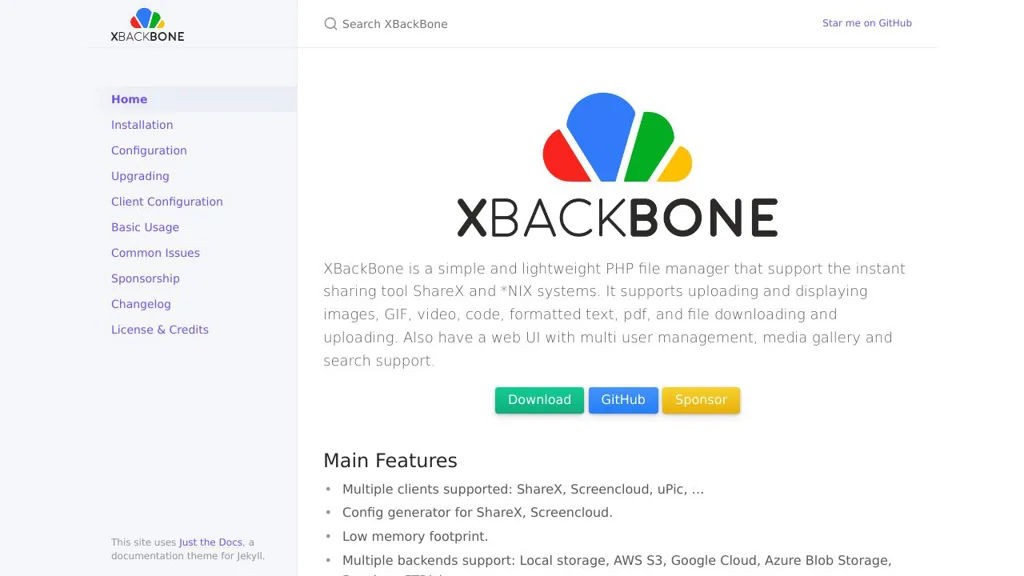
xBackBone screenshot

xBackBone is a self-hosted web application for uploading and sharing files and screenshots through a clean web UI and direct links. It’s commonly used as a private alternative to public “file drop” and image hosting services, with user management and link controls.

Key Features

  • Web-based upload and file manager with searchable list views
  • Shareable direct links for files (suitable for quickly sending to others)
  • Optional link expiration / one-time or time-limited sharing (where configured)
  • User authentication with multi-user support and per-user content separation
  • Screenshot-oriented workflow (commonly paired with ShareX and similar tools)
  • Basic organization/metadata (filename, size, upload time) and admin controls
  • API endpoints intended for automation and uploader clients

Use Cases

  • Private replacement for Imgur/WeTransfer-style link sharing
  • Team or homelab “drop zone” for quickly exchanging files and screenshots
  • Integrating with screenshot tools (e.g., ShareX) for instant uploads

Limitations and Considerations

  • Not a full sync platform (no desktop sync like Drive/Dropbox)
  • Feature depth (previewing, advanced permissions, collaboration) is limited vs. enterprise DAM platforms

xBackBone fits best when you want a lightweight, private upload-and-share service with direct links and simple administration. It’s particularly useful for fast screenshot sharing and ad-hoc file transfers without relying on third-party hosts.

1.1kstars
90forks
#14
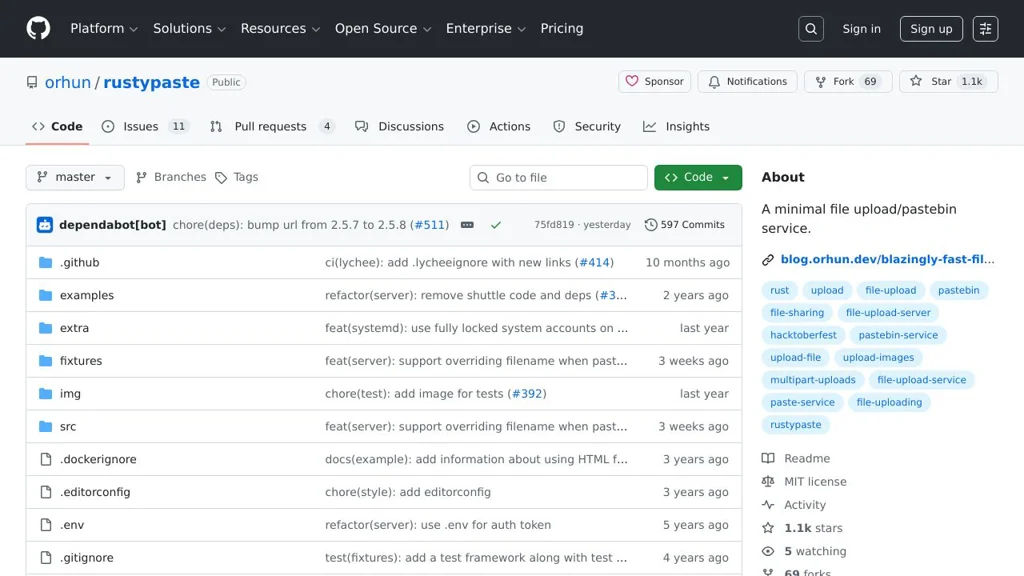
Rustypaste

Rustypaste

Rustypaste is a lightweight pastebin and file upload server with configurable storage, expiry, and optional authentication for sharing text and files over HTTP.

Rustypaste screenshot

Rustypaste is a small, fast pastebin and file upload service written in Rust. It provides a simple HTTP interface for uploading files (including text pastes) and serving them back via shareable URLs, with configuration aimed at safe and convenient personal or team use.

Key Features

  • HTTP endpoints for uploading and downloading shared files/pastes
  • Configurable storage backend on disk with directory layout controls
  • Optional expiry/retention settings for uploaded content
  • Limits and controls (e.g., maximum upload size) to reduce abuse
  • Optional authentication/token-based protection for uploads (configurable)
  • Simple configuration file and environment-based configuration support
  • Designed to be lightweight and easy to run behind a reverse proxy

Use Cases

  • Host a private pastebin for sharing logs/snippets within a team
  • Temporary file drop for sharing artifacts (screenshots, binaries) via URL
  • Lightweight “share this file quickly” endpoint for scripts and automation

Limitations and Considerations

  • Not intended as a full collaboration platform (no rich editor, comments, or versioning)
  • Feature set is intentionally minimal; advanced moderation/anti-abuse features may require a reverse proxy/WAF

Rustypaste fits users who want a minimal, performant paste/file sharing endpoint with straightforward configuration and predictable behavior. It is especially suitable when you want a simple URL-based sharing workflow without the complexity of larger file-sharing suites.

1.1kstars
69forks
#15
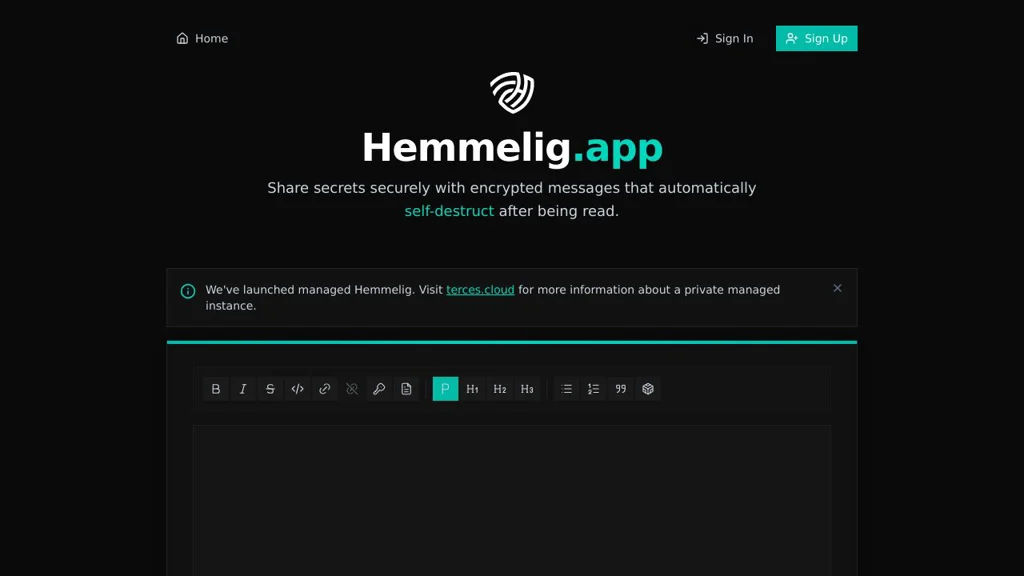
Hemmelig

Hemmelig

Self-hosted secret sharing and paste service with E2EE, expiring links, view limits, and optional passwords—built for safely sharing sensitive text and files.

Hemmelig screenshot

Hemmelig is a self-hosted secret sharing service for securely sending sensitive information (tokens, passwords, notes, and files) using end-to-end encryption in the browser. It creates shareable links that can be configured to expire, be viewed only a limited number of times, and optionally require a password.

Key Features

  • End-to-end encryption (encryption/decryption happens client-side)
  • One-time or limited-view secrets with configurable view count
  • Expiration controls (time-based) to automatically invalidate secrets
  • Optional password protection in addition to E2EE
  • File and text secret support (depending on deployment configuration)
  • Simple web UI for creating and retrieving secrets
  • API support for programmatic secret creation (documented in project materials)

Use Cases

  • Share deployment credentials, API keys, and recovery codes with teammates
  • Send temporary access details to contractors with automatic expiry
  • Provide one-time links for sensitive onboarding information

Limitations and Considerations

  • E2EE means lost client-side password/key cannot be recovered by the server
  • Operational security depends on correct HTTPS/TLS setup and secure hosting

Hemmelig is suited for organizations and individuals who need a straightforward, auditable way to share secrets with strong client-side encryption and automatic lifetimes. It focuses on minimizing exposure by limiting how long and how often a secret can be accessed.

1.1kstars
89forks

Why choose an open source alternative?

  • Data ownership: Keep your data on your own servers
  • No vendor lock-in: Freedom to switch or modify at any time
  • Cost savings: Reduce or eliminate subscription fees
  • Transparency: Audit the code and know exactly what's running