
Dillinger

Best Self Hosted Alternatives to Dillinger

A curated collection of the 6 best self hosted alternatives to Dillinger.

Dillinger is a browser-based Markdown editor for creating, editing and exporting Markdown documents. It offers live preview, export to HTML/PDF, and integrations with cloud storage services (Dropbox, Google Drive, GitHub) to save and sync files.

Alternatives List

#1
Joplin

Joplin

Cross-platform note-taking and knowledge management app with Markdown, attachments, Web Clipper, offline-first sync, and optional end-to-end encryption.
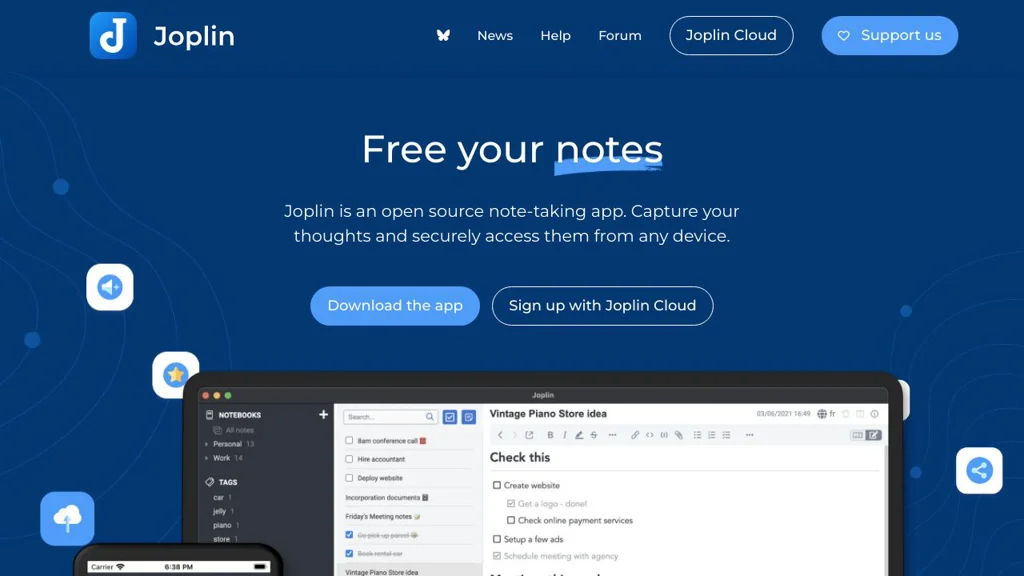
Joplin screenshot

Joplin is a cross-platform note-taking and personal knowledge management application for creating and organizing notes in Markdown with attachments. It is designed for offline-first use and can sync across devices via multiple backends, with optional end-to-end encryption.

Key Features

  • Markdown editor with preview (and rich-text editing mode) for notes
  • Notebook and sub-notebook organization, tagging, and search
  • Web Clipper to save web pages and screenshots into notebooks
  • File attachments (images, PDFs, and other files) and inline rendering where supported
  • End-to-end encryption for synced data (E2EE)
  • Multiple sync targets: Joplin Server, WebDAV, Dropbox, OneDrive, and local filesystem
  • Cross-platform clients: desktop (Windows/macOS/Linux), mobile (Android/iOS), and CLI
  • Plugin system for extending desktop features (themes, editors, integrations)
  • Note history/restore (note revisions) and conflict handling
  • Import/export options (including ENEX and Markdown) for migration

Use Cases

  • Personal knowledge base with searchable Markdown notes and tags
  • Research collection using Web Clipper to archive articles and references
  • Team or multi-device note syncing using Joplin Server or WebDAV with E2EE

Limitations and Considerations

  • Real-time multi-user collaborative editing is not a core feature; sharing/collaboration depends on Joplin Server capabilities and workflow
  • Some advanced features (plugins, certain editor capabilities) are primarily available on desktop

Joplin fits users who want a privacy-focused, offline-capable notes system with flexible sync options and extensibility. It is especially suitable when Markdown, attachments, and encryption are key requirements while keeping data portable via import/export.

52.8kstars
5.7kforks

#2
Trilium Notes

Trilium Notes

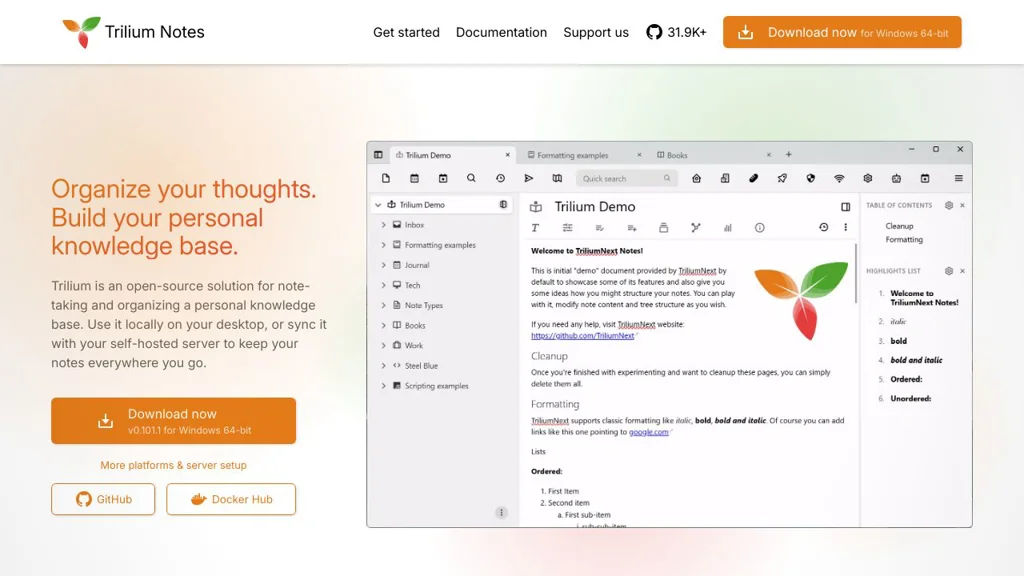
Self-hostable personal knowledge base with a tree-structured notebook, rich-text and code notes, backlinks, full-text search, and scripting/automation.

Trilium Notes screenshot

Trilium Notes is a personal knowledge base for organizing notes in a hierarchical tree while also supporting cross-linking between notes. It combines a fast web UI, rich editing (including code and Markdown), and powerful search to manage large, interlinked knowledge collections.

Key Features

  • Tree-structured notebooks with cloning (same note in multiple places)
  • Rich-text (WYSIWYG) editing plus code notes with syntax highlighting
  • Markdown import/export and other bulk import/export options
  • Bidirectional links and backlinks; note relations/attributes and tagging
  • Full-text search with filtering to navigate large note collections
  • Versioning/revision history for notes
  • Web clipper for capturing content into notes
  • Scripting/automation (JavaScript) and custom widgets for extending behavior

Use Cases

  • Personal knowledge management (Zettelkasten-style linking, research notes)
  • Technical documentation and “second brain” for projects (snippets, runbooks)
  • Journaling and structured life logs organized by a timeline/tree

Limitations and Considerations

  • Collaboration features are limited compared with team-first tools (e.g., comments, real-time multi-user editing)
  • The data model (tree + clones + attributes) can require a learning period for new users

Trilium is well-suited for users who want a fast, local-first feeling knowledge base with a strong hierarchy, links, and extensibility. It is commonly used as a private alternative to commercial note and knowledge apps while retaining advanced organization and automation capabilities.

33.9kstars
2.3kforks
#3
HedgeDoc

HedgeDoc

Self-hosted, real-time collaborative Markdown editor for teams, with note sharing, history, and flexible publishing via links and permissions.

HedgeDoc screenshot

HedgeDoc is a web-based, collaborative Markdown note editor designed for teams to write together in real time. It focuses on fast note creation, easy sharing, and flexible publishing, while still supporting structured organization and access control.

Key Features:

  • Real-time collaborative editing for Markdown documents
  • Markdown preview and formatting helpers, including syntax highlighting for code blocks
  • Multiple sharing and publishing modes (private notes, shared links, published notes)
  • Note history/revisions to track and restore changes
  • User accounts and team collaboration features (permissions depend on configuration)
  • External authentication support via common identity providers (e.g., LDAP/OAuth/OIDC depending on setup)
  • Export/share notes in common formats (e.g., Markdown) and embed-friendly published views

Use Cases:

  • Collaborative meeting notes, sprint notes, and incident write-ups
  • Lightweight internal documentation and how-to pages for teams
  • Publishing announcements or public notes with shareable URLs

Limitations and Considerations:

  • Advanced wiki-style information architecture (hierarchical pages, strong interlinking, graph views) is not the primary focus compared to dedicated wiki platforms.

HedgeDoc is well-suited when you want a simple, fast, multi-user Markdown editor with real-time collaboration and straightforward ways to share or publish notes. It fits teams that value “write together now” workflows over heavyweight document management.

6.8kstars
517forks
#4
SilverBullet

SilverBullet

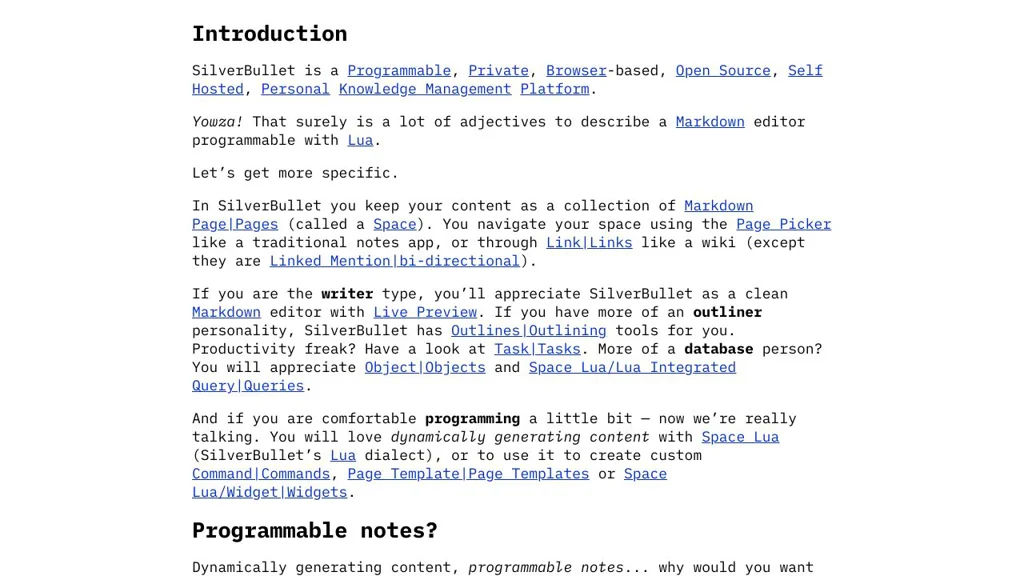
Self-hosted, markdown-based personal knowledge base with backlinks, full-text search, and a programmable extension system for automations and custom commands.

SilverBullet screenshot

SilverBullet is a markdown-first personal knowledge base (PKM) and wiki that runs in your browser with a server-backed file store. It focuses on fast note navigation (links, backlinks, search) and on extensibility: you can automate workflows and customize behavior using scripts and plug-ins.

Key Features

  • Markdown-based pages stored as plain files, editable in a web UI
  • Wiki-style linking with backlinks for knowledge graph-style navigation
  • Full-text search across pages
  • Extensible architecture: plug-ins and user scripts to add commands, panels, and behaviors
  • Built-in command palette for quick navigation and actions
  • Templates/snippets and metadata via frontmatter for structured notes
  • Multi-device access via the web interface (single server, many clients)

Use Cases

  • Personal wiki for meeting notes, project journals, and daily logs
  • Team “lightweight wiki” for documentation where plain markdown files are preferred
  • Power-user note system with custom commands (e.g., automations, page generators)

Limitations and Considerations

  • Extension power comes with a learning curve (scripting/plug-ins) for advanced customization
  • Best suited to wiki/PKM workflows; not a full project management suite

SilverBullet is a good fit if you want a browser-based markdown wiki that stays file-oriented while still being highly customizable. Its link-centric navigation and programmable extension model make it especially useful for users who want to tailor their note-taking system to their own workflows.

4.5kstars
331forks
#5
Flatnotes

Flatnotes

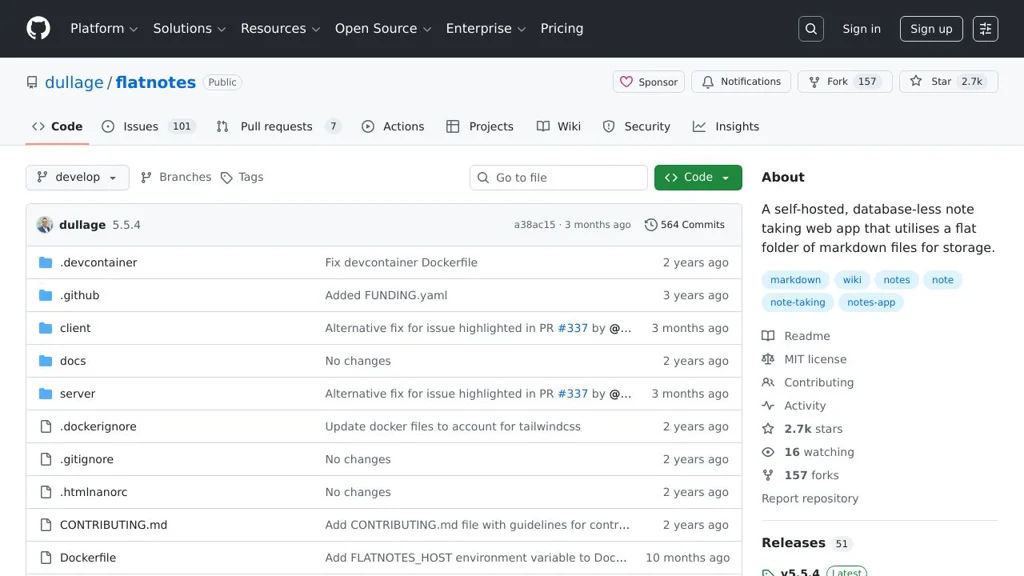
Flatnotes is a lightweight web app for managing Markdown notes stored as plain text files, with tag support and fast full-text search.

Flatnotes screenshot

Flatnotes is a minimalist, self-contained web application for writing and organizing notes as local Markdown files (a “flat-file” notebook). It focuses on speed and simplicity: you edit notes in the browser, while the source of truth remains a folder of plain-text files.

Key Features

  • Flat-file storage: notes are plain Markdown files on disk (easy to back up and sync externally)
  • Web-based editor for creating, editing, and deleting notes
  • Fast full-text search across all notes
  • Tagging and tag-based filtering (tags derived from note metadata/content)
  • Simple navigation UI designed for quick capture and retrieval
  • Docker-first deployment (commonly run as a single container)

Use Cases

  • Personal knowledge base using a local Markdown folder
  • A lightweight “notes inbox” for quick capture with later organization via tags/search
  • Self-hosted alternative for users who want notes to stay as files rather than in a database

Limitations and Considerations

  • Primarily designed for personal/single-user workflows; advanced multi-user collaboration features are not a focus
  • Feature set is intentionally minimal compared with full PKM suites (e.g., graph views, rich backlinks)

Flatnotes is a good fit when you want a fast web UI on top of a directory of Markdown notes, keeping data portable and easy to manage with existing filesystem-based tooling. Its opinionated simplicity makes it easy to deploy and maintain while still providing the essentials: editing, tags, and search.

2.7kstars
157forks
#6
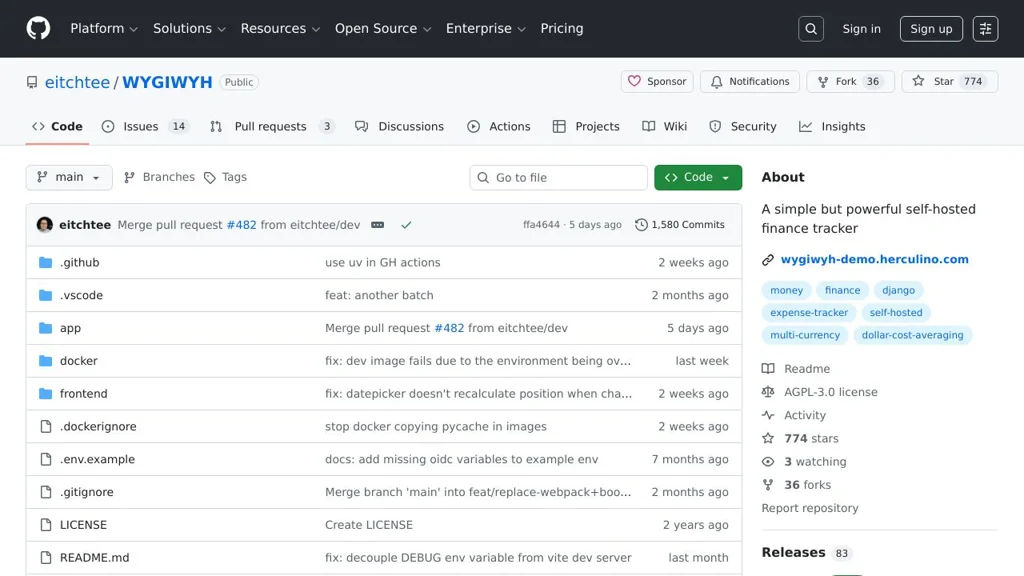
WYGIWYH

WYGIWYH

WYGIWYH is a lightweight web app that previews Markdown as styled HTML, aiming to mirror final output so you can write with confidence.

WYGIWYH screenshot

WYGIWYH is a small, self-hostable “what you get is what you have” Markdown previewer focused on showing Markdown content as it will look when rendered. It emphasizes simple setup and a browser-based writing/preview experience.

Key Features

  • Live Markdown preview rendered to HTML in the browser
  • Styling focused on producing consistent, publication-like output
  • Minimal, lightweight project intended for quick local or server deployment

Use Cases

  • Draft and preview README/docs content before publishing to GitHub/GitLab
  • Prepare Markdown content for static-site/blog engines with predictable rendering
  • Quickly share a local preview environment with teammates during documentation work

Limitations and Considerations

  • Primarily a preview tool; not a full documentation portal or wiki (no built-in navigation, search, or multi-page publishing workflow)

WYGIWYH is best suited for users who want a straightforward Markdown-to-HTML preview with consistent styling. If you need publishing workflows, collaboration, or a full documentation site, a dedicated docs platform or wiki will be a better fit.

784stars
36forks

Why choose an open source alternative?

  • Data ownership: Keep your data on your own servers
  • No vendor lock-in: Freedom to switch or modify at any time
  • Cost savings: Reduce or eliminate subscription fees
  • Transparency: Audit the code and know exactly what's running