
#1
Zot
Zot is an OCI-compliant container registry for storing, signing, and distributing container images and OCI artifacts with a web UI, API, and multiple storage backends.
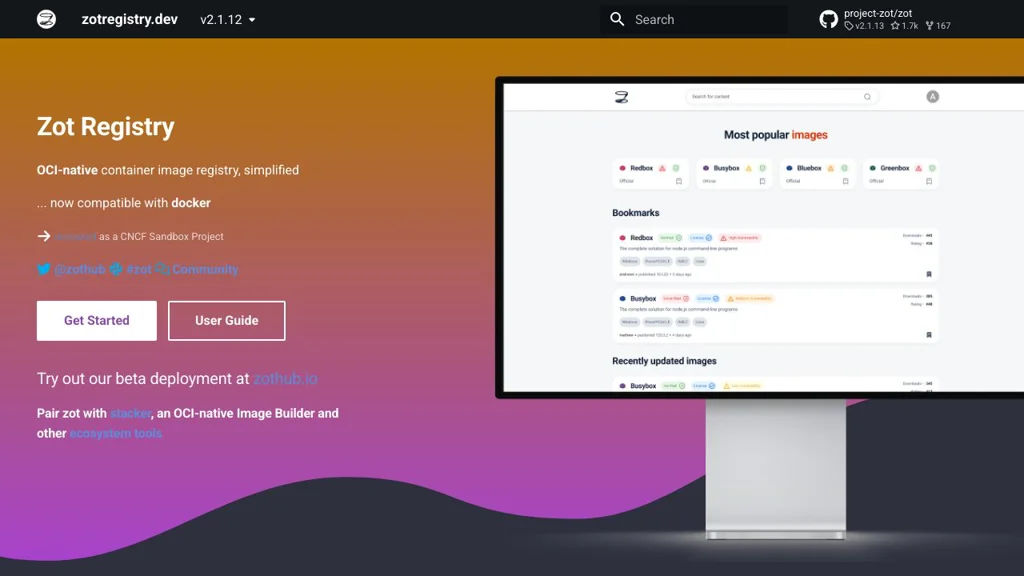
Zot is an OCI-native registry server for storing and distributing container images and other OCI artifacts. It focuses on standards compliance (OCI Distribution/Artifacts) and provides both a registry API and a built-in web UI for browsing repositories, tags, and manifests.
Key Features
- Implements the OCI Distribution Specification for pushing/pulling images and artifacts
- Web UI for browsing repositories, tags, manifests, and image details
- Supports OCI artifacts beyond images (artifact-centric registry usage)
- Pluggable storage backends (filesystem and cloud/object backends depending on configuration)
- AuthN/AuthZ options via configuration (e.g., basic auth and other modes as supported)
- Image signing and verification workflows via OCI artifact/signature integrations (where configured)
Use Cases
- Private container registry for Kubernetes/CI pipelines to host images internally
- Hosting and distributing OCI artifacts (e.g., signatures/SBOM-style artifacts) alongside images
- Edge/air-gapped environments needing a lightweight registry with a simple UI
Limitations and Considerations
- Feature depth varies by configuration and enabled extensions; some enterprise registry conveniences (advanced replication/policy engines) may require additional tooling
Zot is suited for teams that want a standards-first OCI registry with a straightforward deployment model and optional UI, while keeping compatibility with common container tooling. It is commonly considered when you need an OCI registry that can also serve as a general OCI artifact store.
1.7kstars
167forks