
Document360

Best Self Hosted Alternatives to Document360

A curated collection of the 6 best self hosted alternatives to Document360.

Document360 is a knowledge base SaaS for creating, managing and publishing self-service documentation and internal knowledge. It offers article authoring, versioning, category management, search, analytics and integrations for support and product teams.

Alternatives List

#1
Wiki.js

Wiki.js

A Node.js-based wiki for team documentation and knowledge bases with Markdown, rich editor, permissions, Git sync, and multiple authentication options.
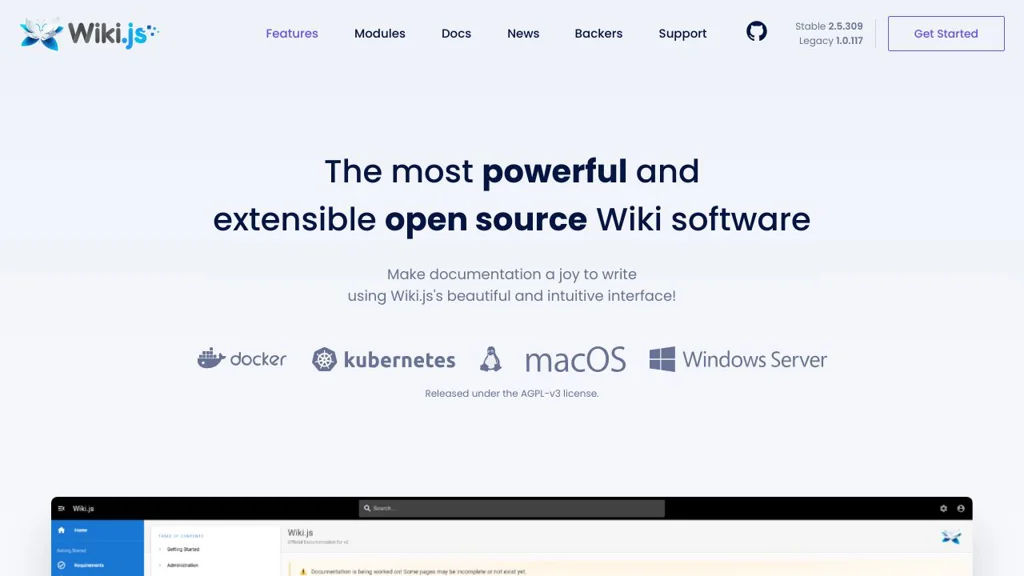
Wiki.js screenshot

Wiki.js is a modern wiki and documentation platform designed for teams to create, organize, and publish internal knowledge and technical documentation. It focuses on a clean authoring experience (Markdown and visual editing), flexible content organization, and enterprise-style access controls.

Key Features

  • Markdown editor and visual (WYSIWYG) editing experience for pages
  • Powerful content organization with navigation, pages, and hierarchy
  • Fine-grained access control with roles and permissions
  • Authentication integrations (e.g., local auth and external identity providers)
  • Version history and page revisions with restore/compare capabilities
  • Git-based storage/synchronization options for backing content with repositories
  • Search functionality for quickly finding content across the wiki
  • Extensible architecture with modules/integrations (e.g., storage, auth, rendering)

Use Cases

  • Internal company wiki for SOPs, onboarding, and team knowledge sharing
  • Engineering documentation portal for runbooks, architecture docs, and APIs
  • Project documentation site with controlled access for stakeholders

Limitations and Considerations

  • Some advanced capabilities depend on configuring modules (auth/storage/search) and may require additional services
  • Major version upgrades can require migration planning due to platform changes

Wiki.js is well-suited for organizations that want a polished documentation experience with strong permissions and integration options. Its modular approach makes it adaptable to different infrastructures, from small teams to larger environments with SSO and Git-backed workflows.

27.6kstars
3.1kforks

#2
Docmost

Docmost

Self-hosted collaborative wiki and knowledge base with pages, spaces, permissions, and full-text search for internal documentation.

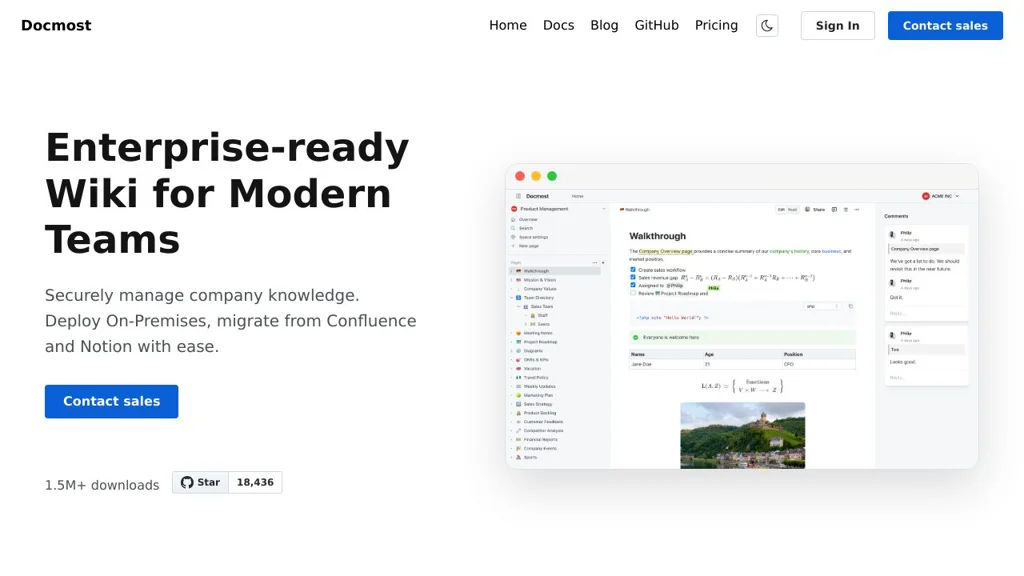
Docmost screenshot

Docmost is a self-hosted, collaborative wiki for creating and organizing internal documentation and team knowledge. It focuses on structured content (spaces and pages), collaborative editing, and search, making it suitable for product docs, runbooks, and internal knowledge bases.

Key Features

  • Spaces and hierarchical pages for structured documentation
  • Rich-text/Markdown-style editor for writing and formatting content
  • Real-time collaboration features for team editing and updates
  • Permissions and access control for organizing content by team/space
  • Full-text search to quickly find pages and information
  • Attachments and media support for documentation assets

Use Cases

  • Internal engineering runbooks, SOPs, and incident playbooks
  • Company knowledge base (policies, onboarding, FAQs)
  • Product/ops documentation organized by teams or projects

Docmost provides a lightweight Confluence/Notion-style documentation experience that can be deployed on your own infrastructure. It is best suited for teams that want a focused wiki/knowledge base with collaboration, permissions, and search without relying on a hosted SaaS.

18.5kstars
1.1kforks
#3
BookStack

BookStack

BookStack is a self-hosted wiki and documentation platform with a book/chapter/page structure, full-text search, WYSIWYG and Markdown editing, and role-based access control.

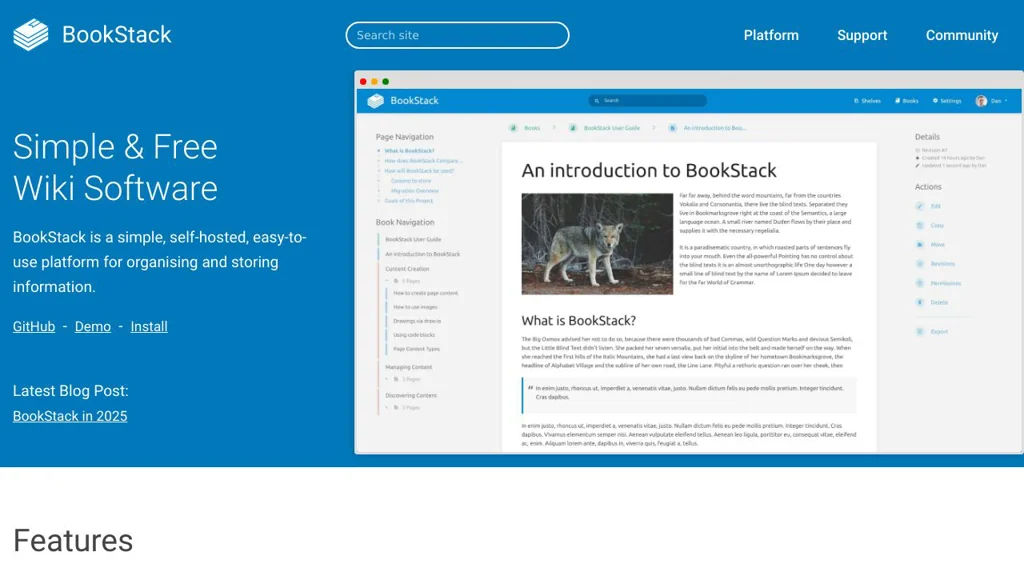
BookStack screenshot

BookStack is a web-based documentation and wiki platform designed for creating and organizing content in a clear hierarchy of Books, Chapters, and Pages. It provides an approachable editing experience while still supporting richer technical workflows for teams that need structured internal documentation.

Key Features

  • Structured content model: Books → Chapters → Pages (plus optional “Shelves” to group books)
  • WYSIWYG editor with Markdown support, including code blocks and formatting tools
  • Granular permissions & roles to control access at shelf/book/chapter/page levels
  • Full-text search across content to quickly find pages and references
  • Page revision history with change tracking and the ability to review/restore past versions
  • Images and file attachments management for documentation assets
  • Linkable content with easy page linking and navigation via a consistent hierarchy
  • Authentication options including LDAP integration and SSO via SAML2/OAuth2 (via supported identity providers)
  • REST API for integrating content and automating documentation workflows
  • Theme and customization options (including customization via configuration and UI styling)

Use Cases

  • Internal team knowledge base for SOPs, runbooks, onboarding, and troubleshooting guides
  • Product/engineering documentation with organized manuals and versionable pages
  • Lightweight company wiki for policies, processes, and cross-team collaboration

Limitations and Considerations

  • Content organization is opinionated around the book/chapter/page hierarchy, which may not suit all wiki styles
  • Real-time collaborative editing (simultaneous co-authoring like Google Docs) is not the primary editing model

BookStack is well-suited for teams that want a clean, navigable documentation system without the complexity of a full CMS. Its structured hierarchy, permissions, and revision history make it a practical choice for maintaining internal documentation at scale.

18kstars
2.3kforks
#4
DokuWiki

DokuWiki

A PHP wiki that stores pages as text files, offering ACL, versioning, plugins, and structured navigation without requiring a database.

DokuWiki screenshot

DokuWiki is a lightweight, PHP-based wiki engine designed for documentation and knowledge bases. It stores content as plain text files (no database required), making it easy to deploy, back up, and migrate while still supporting multi-user collaboration.

Key Features

  • Plain-text file storage with automatic revision history and diff viewing
  • Built-in Access Control Lists (ACL) for namespaces/pages and user/group permissions
  • Full-text search and structured navigation using namespaces and backlinks
  • Plugin and template ecosystem for extending functionality and theming
  • Media management for file uploads and embedding images/documents
  • Interwiki links, page locking, and conflict handling for concurrent edits
  • Built-in authentication options with support for external auth via plugins

Use Cases

  • Internal team wiki for SOPs, runbooks, and technical documentation
  • Project documentation portal for software/hardware teams
  • Personal or small-organization knowledge base with fine-grained permissions

Limitations and Considerations

  • Does not use Markdown by default (uses DokuWiki syntax; Markdown available via plugins)
  • Advanced workflows (e.g., WYSIWYG editing, complex approvals) typically require plugins

DokuWiki is well-suited for teams that want a dependable wiki with minimal operational dependencies and strong permissioning. Its file-based design and mature extension ecosystem make it a practical choice for long-lived documentation.

4.5kstars
911forks
#5
Raneto

Raneto

Self-hosted, file-based knowledge base and documentation portal built with Node.js and Markdown.

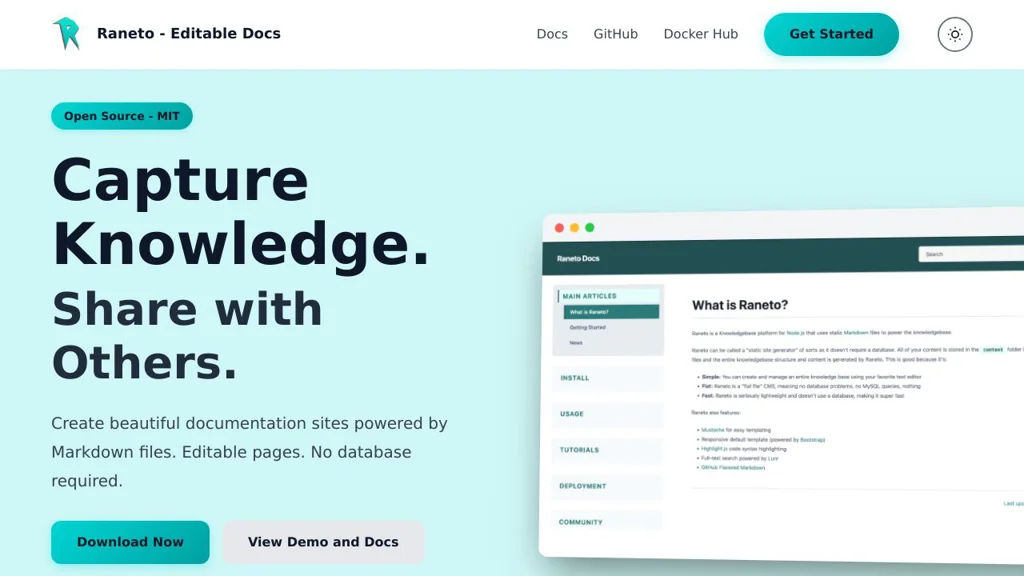
Raneto screenshot

Raneto is a lightweight knowledge base and documentation portal that renders a folder of Markdown files into a searchable web site. It is designed to be easy to deploy and manage, using simple files on disk instead of a database.

Key Features

  • Markdown-based content stored as plain files/folders (Git-friendly)
  • Automatic navigation generated from the directory structure
  • Built-in search across pages
  • Configurable UI (theme/customization via config)
  • Optional authentication to restrict access
  • Supports images and other static assets in the content tree

Use Cases

  • Internal team knowledge base and runbooks
  • Product or project documentation site from a Git repository
  • Simple “wiki-like” documentation for small orgs without a CMS

Limitations and Considerations

  • Project appears largely unmaintained compared to newer documentation platforms
  • File-based workflow is simple but lacks advanced wiki features (e.g., granular permissions, rich collaboration)

Raneto fits teams that want a minimal, Markdown-first documentation portal that can be versioned with Git and deployed quickly. It is most suitable when simplicity and file-based editing matter more than advanced editorial workflows or enterprise governance.

2.9kstars
439forks
#6
XWiki

XWiki

Java-based enterprise wiki for collaborative documentation with extensions, scripting, workflows, access control, and full version history.

XWiki screenshot

XWiki is a Java-based wiki and collaboration platform designed for creating and managing structured knowledge bases, intranets, and documentation sites. It combines classic wiki editing with an extensible application framework (pages, objects, scripts, extensions) to build custom collaborative apps.

Key Features

  • Rich wiki pages with attachments, full version history, and diffs/rollback
  • Fine-grained permissions with groups/users and rights management
  • Powerful extension system (XWiki Extension Manager) to add apps/features
  • Scripting and templating capabilities to build applications inside the wiki
  • Structured data via “objects” attached to pages (forms/metadata)
  • Search across content and attachments (configurable search backends)
  • Collaboration features: comments, notifications, and activity tracking (depending on installed apps)
  • REST APIs for integrating and automating content operations

Use Cases

  • Team knowledge base / internal documentation portal
  • Company intranet with spaces for departments and projects
  • Custom lightweight business apps (forms + workflows) built on wiki data

Limitations and Considerations

  • Advanced functionality often depends on installing/configuring extensions
  • Operating at scale typically requires tuning the servlet container, database, and search backend

XWiki is a mature, modular platform suited for organizations that need a customizable wiki beyond simple page editing. Its extension ecosystem and in-wiki development model make it practical for both documentation and bespoke collaborative applications.

1.2kstars
611forks

Why choose an open source alternative?

  • Data ownership: Keep your data on your own servers
  • No vendor lock-in: Freedom to switch or modify at any time
  • Cost savings: Reduce or eliminate subscription fees
  • Transparency: Audit the code and know exactly what's running