
IRCCloud

Best Self Hosted Alternatives to IRCCloud

A curated collection of the 3 best self hosted alternatives to IRCCloud.

Hosted IRC client and service offering persistent connections, web and mobile apps, searchable message history, logging, push notifications and team collaboration features to keep users connected to IRC even when offline.

Alternatives List

#1
The Lounge

The Lounge

A self-hosted, browser-based IRC client with persistent connections, multi-user access, theming, and extensibility via plugins.
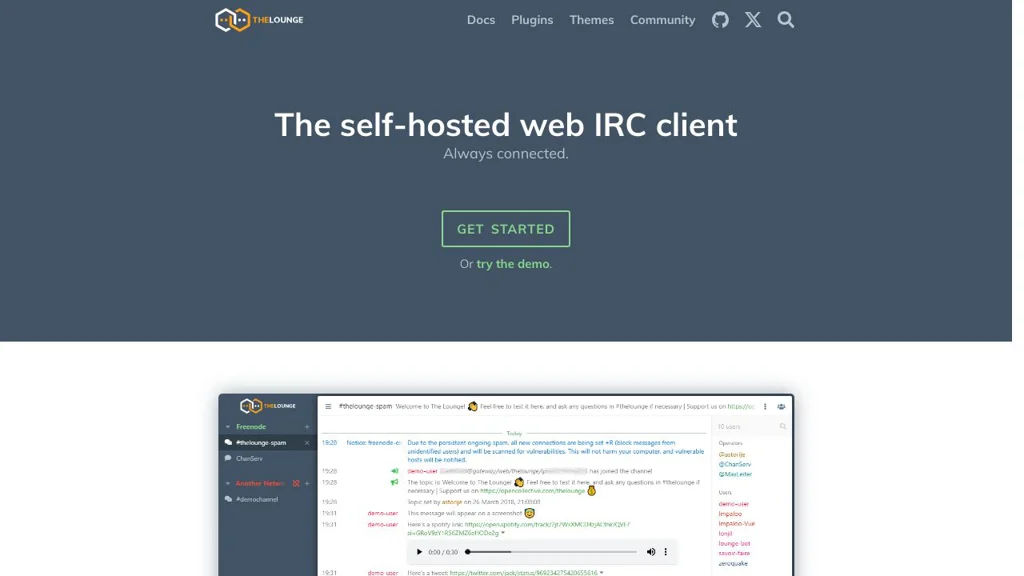
The Lounge screenshot

The Lounge is a web-based IRC client you host yourself, designed to keep IRC connections persistent on the server while users connect through a modern browser UI. It supports multiple IRC networks, multiple users, and works well for running always-on IRC sessions from any device.

Key Features

  • Persistent IRC connections handled server-side (stays connected even when the browser closes)
  • Multi-network and multi-channel support with an organized web interface
  • Multi-user mode with authentication and per-user configurations
  • IRCv3 capabilities support (where available) such as SASL authentication and modern server features
  • Message history/backlog and scrollback in the web UI (based on server-side buffering)
  • Theming support and a plugin/extension system for customization
  • Responsive UI suitable for desktop and mobile browsers

Use Cases

  • Provide a shared, always-on IRC web client for a team/community
  • Access IRC from restrictive networks or devices without an installed IRC client
  • Centralize long-running IRC sessions (bouncers-like workflow) with a modern UI

Limitations and Considerations

  • Not a full IRC bouncer replacement for every workflow; feature depth depends on IRC server capabilities and configuration
  • Requires running a Node.js service and managing user access/security like any web app

It is commonly used by IRC communities and teams that want a polished, persistent web interface without relying on third-party hosted IRC web clients. The Lounge balances a modern UX with traditional IRC concepts, and is extensible for advanced deployments.

6.1kstars
732forks

#2
Ergo

Ergo

Ergo is a modern, self-contained IRCv3 server with integrated services (NickServ/ChanServ), TLS, history playback, bouncers, and extensive IRCv3 capability support.

Ergo screenshot

Ergo is an IRC server that focuses on modern IRCv3 features while staying easy to run as a single, self-contained daemon. It bundles “IRC services” functionality (accounts, channel registration, etc.) directly into the server and emphasizes secure defaults and a good experience for always-on and mobile clients.

Key Features

  • Broad IRCv3 support (capabilities, message tags, modern client features)
  • Integrated services: account registration/login, nickname enforcement, channel registration and management
  • Persistent history playback (including modern replay mechanisms for clients that support them)
  • Built-in bouncer-style functionality for always-on connections and better mobile experience
  • TLS/SSL support and common security hardening options (e.g., connection and auth controls)
  • Highly configurable via a YAML-based configuration file
  • Designed as a single binary/daemon with minimal external dependencies

Use Cases

  • Host a private IRC network for a team, community, or friends with modern client compatibility
  • Provide a stable IRC home with account-based identity and registered channels
  • Run an IRC network optimized for mobile/roaming clients with history replay and bouncer features

Limitations and Considerations

  • Best user experience depends on IRCv3-capable clients (older clients won’t benefit from modern features)
  • IRC ecosystem varies by client; some advanced capabilities may not be uniformly supported

Ergo is well-suited for administrators who want an IRC network with modern usability features without deploying separate “services” components. Its integrated approach and IRCv3 focus make it a practical choice for secure, always-on IRC communities.

3kstars
220forks
#3
Convos

Convos

Self-hosted web IRC client for individuals or teams with multi-user accounts, bouncer-like always-on connections, and a modern browser UI.

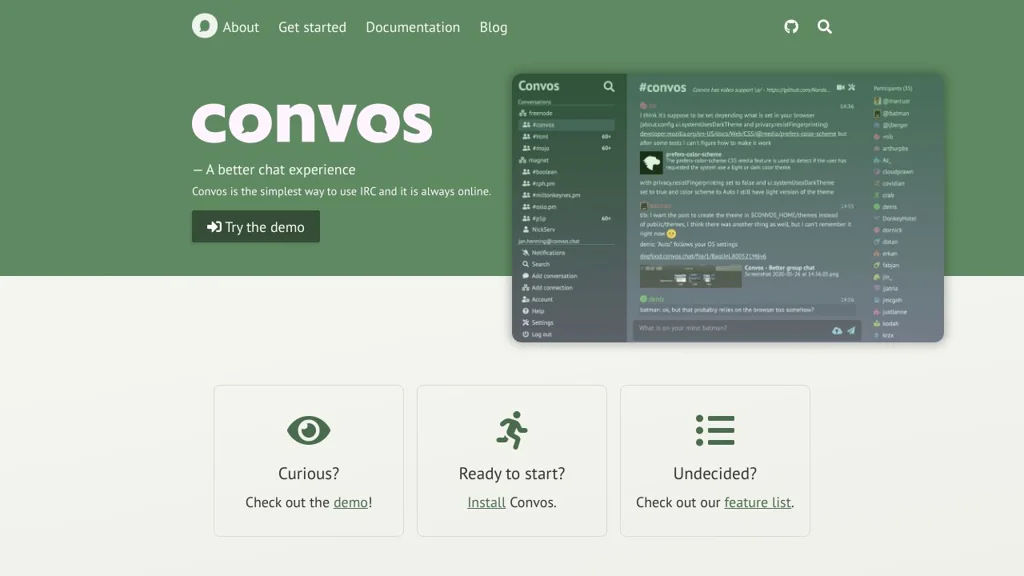
Convos screenshot

Convos is a self-hosted, browser-based IRC client designed to make IRC accessible with a modern web UI while keeping connections and chat history available across devices. It supports both single-user and multi-user deployments and can be run as a long-lived service so your IRC connections stay online.

Key Features:

  • Web IRC client UI for networks, channels, and private messages
  • Multi-user support (suitable for teams) with separate accounts
  • Always-on server process (bouncer-like) to keep IRC connections alive
  • Persistent logs/history stored server-side for later viewing
  • Notifications and highlights support (client UI feature)
  • Deployable via container images and typical service managers

Use Cases:

  • Replace hosted web IRC clients for personal IRC access from any browser
  • Provide a shared, self-hosted IRC web gateway for a team/community
  • Run an always-on IRC session to avoid missing messages while offline

Convos is a practical option if you want an IRC-focused web chat experience with persistent connectivity and multi-user operation. It fits well for users who still rely on IRC networks and want a modern interface without depending on third-party hosted web IRC services.

1.1kstars
92forks

Why choose an open source alternative?

  • Data ownership: Keep your data on your own servers
  • No vendor lock-in: Freedom to switch or modify at any time
  • Cost savings: Reduce or eliminate subscription fees
  • Transparency: Audit the code and know exactly what's running