
Signal

Best Self Hosted Alternatives to Signal

A curated collection of the 4 best self hosted alternatives to Signal.

Signal is a privacy-focused messaging app offering end-to-end encrypted text, voice, video, and file communications. Open-source and run by the Signal Foundation, it prioritizes user privacy and secure, ad-free messaging across mobile and desktop.

Alternatives List

#1
SimpleX Chat

SimpleX Chat

Privacy-first messenger using SimpleX relays and end-to-end encryption, designed to avoid user identifiers, phone numbers, and centralized identity.
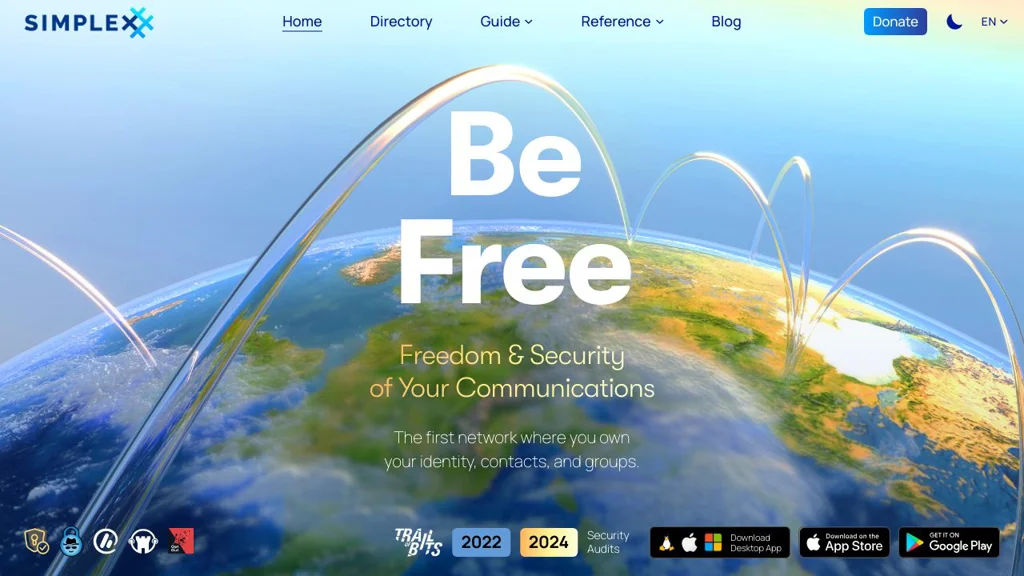
SimpleX Chat screenshot

SimpleX Chat is a privacy-focused messaging system built to minimize metadata by avoiding global user identifiers (no phone numbers, usernames, or accounts). It uses the SimpleX messaging protocol and relay servers to deliver end-to-end encrypted messages while aiming to keep social graphs and contact discovery off centralized infrastructure.

Key Features

  • No user IDs: contacts are added via invitation links/QR codes rather than usernames or phone numbers
  • End-to-end encryption with authentication and forward secrecy-oriented session design (protocol-level encryption)
  • Relay-based message delivery using SimpleX servers; clients can use public relays or run their own
  • Private contact connections and group messaging (group participation without public identity)
  • File and media attachments with encrypted transport
  • Multi-device support (via app clients) and cross-platform availability (desktop/mobile)

Use Cases

  • Secure 1:1 and group conversations for communities that cannot rely on phone-number identity
  • Private coordination for teams or activists needing reduced metadata exposure
  • Self-operated relays for organizations that want control over message transport infrastructure

Limitations and Considerations

  • Contact onboarding relies on exchanging invite links/QRs, which can be less convenient than directory-based messengers
  • Some features and UX may vary by client platform as the ecosystem evolves

SimpleX Chat is a strong option when the primary goal is private messaging with minimal metadata and without account-based identity. Its relay-based architecture and support for running your own servers make it suitable for both personal and organizational deployments where privacy properties matter most.

10.2kstars
538forks
#2
Mumble

Mumble

Open-source VoIP voice chat with low latency, positional audio, access control, and a self-hostable server (Murmur) for teams and communities.

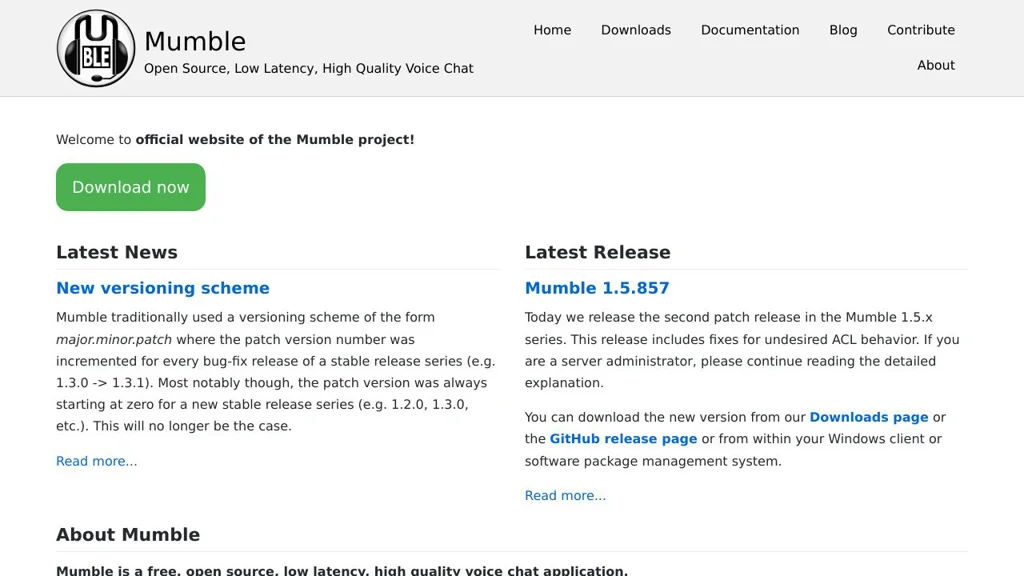
Mumble screenshot

Mumble is an open-source voice-over-IP (VoIP) application designed for low-latency, high-quality voice communication. It uses a client/server architecture: the Mumble desktop/mobile clients connect to the Murmur server, where admins manage channels, permissions, and authentication.

Key Features

  • Low-latency voice communication optimized for group chat
  • Murmur server with hierarchical channels and ACL-based permissions
  • Strong security: TLS-encrypted transport and optional end-to-end encryption (E2EE)
  • Multiple authentication options (e.g., built-in user database and external methods such as LDAP)
  • Opus audio codec support for high quality at low bitrates
  • Positional audio support for games (3D/spatial voice)
  • Text chat, channel messaging, and user status information
  • Cross-platform clients (notably Windows, macOS, Linux; mobile support available)

Use Cases

  • Voice comms for gaming clans and communities needing channels and positional audio
  • Team voice coordination for self-managed organizations (IT/ops, makerspaces, LAN parties)
  • Event voice backchannels with controlled access and moderation via permissions

Limitations and Considerations

  • Primarily focused on audio; it is not a full video-conferencing platform
  • Some advanced identity integrations depend on server configuration and build options

Mumble remains a popular choice for communities that value reliable, low-latency audio and fine-grained server-side control. Its mature ecosystem and performance-focused design make it suitable for both small groups and large, structured voice servers.

7.5kstars
1.3kforks
#3
Chitchatter

Chitchatter

Chitchatter is a serverless, peer-to-peer chat app that uses WebRTC and end-to-end encryption for ephemeral rooms without storing messages on a central server.

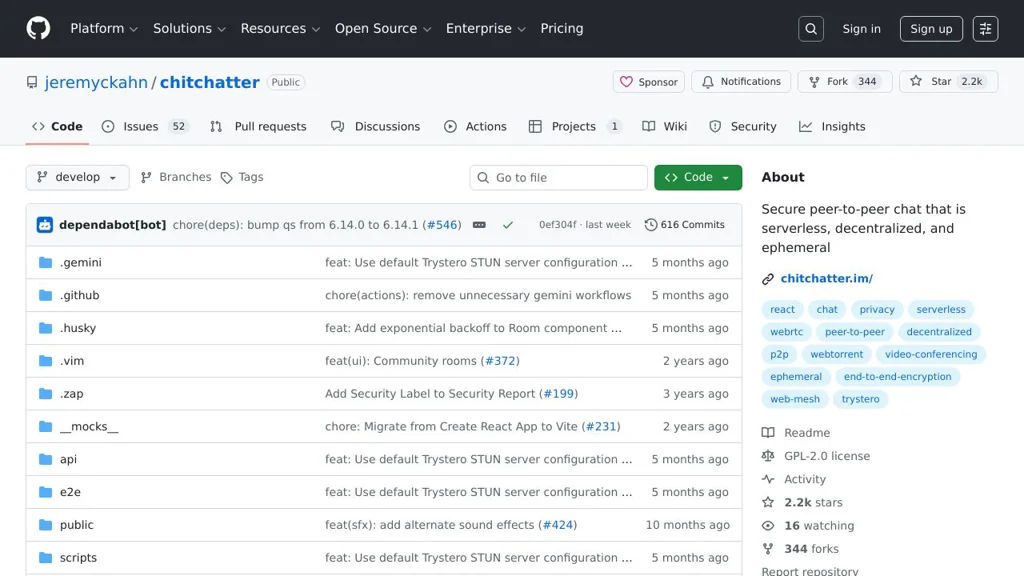
Chitchatter screenshot

Chitchatter is a browser-based chat application designed around privacy and minimal infrastructure. It uses peer-to-peer connections (WebRTC) and end-to-end encryption so participants can communicate without routing messages through an application server. Rooms are ephemeral and oriented toward temporary conversations.

Key Features

  • Peer-to-peer messaging via WebRTC data channels (no central message relay server)
  • End-to-end encryption (E2EE) for message content between participants
  • Ephemeral rooms/conversations (no built-in server-side message storage)
  • Shareable room links for inviting others
  • Runs as a static web app and can be hosted on any static web server

Use Cases

  • Private, temporary group chats for small teams or friends
  • Sharing sensitive information in a short-lived conversation
  • Ad-hoc coordination during events without creating accounts

Limitations and Considerations

  • WebRTC/NAT traversal can be unreliable in some network environments; connectivity may fail without TURN
  • Peer-to-peer architecture typically scales poorly for large rooms compared to server-relayed chat
  • No built-in long-term history since conversations are designed to be ephemeral

Chitchatter is a good fit when you want simple, temporary chat rooms with strong privacy properties and minimal backend requirements. Its P2P/E2EE design prioritizes confidentiality and reduces reliance on central infrastructure, while trading off reliability and scalability typical of WebRTC-based meshes.

2.1kstars
344forks
#4
Databag

Databag

Databag is a self-hosted, end-to-end encrypted messenger with group chat, file sharing, and multi-device access via web and native clients.

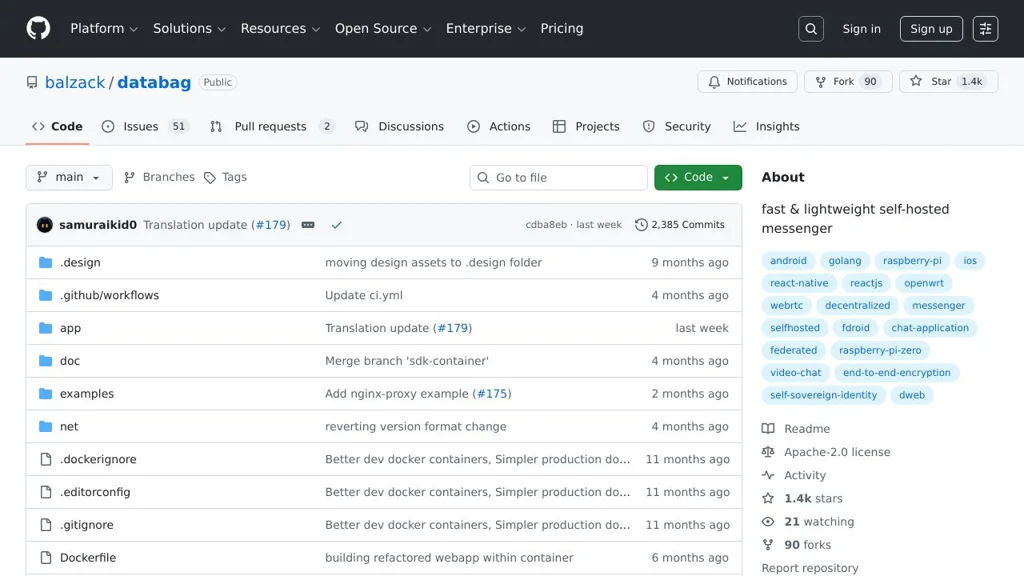
Databag screenshot

Databag is a self-hosted messaging server and set of clients focused on private communication using end-to-end encryption. It provides direct messages and group chat, with an emphasis on keeping message content encrypted so the server primarily stores ciphertext.

Key Features

  • End-to-end encrypted messaging for direct and group conversations
  • Web client plus native clients (project provides multiple client options)
  • File and media sharing within conversations
  • Multi-user server with account management
  • Designed to minimize server-side access to plaintext message content

Use Cases

  • Private team or family chat where the server operator should not read messages
  • Small organizations that need an internal messenger without relying on SaaS
  • Secure group discussions with sharing of attachments and media

Limitations and Considerations

  • Smaller ecosystem than mainstream messengers; integrations and federation may be limited depending on client/support
  • Feature set and client maturity may vary across platforms

Databag is a practical option for running your own encrypted messenger when you want a simple, controlled deployment and encrypted-by-default conversations. It fits best for small groups that value privacy and can standardize on the supported clients.

1.4kstars
91forks

Why choose an open source alternative?

  • Data ownership: Keep your data on your own servers
  • No vendor lock-in: Freedom to switch or modify at any time
  • Cost savings: Reduce or eliminate subscription fees
  • Transparency: Audit the code and know exactly what's running