
TeamViewer

Best Self Hosted Alternatives to TeamViewer

A curated collection of the 4 best self hosted alternatives to TeamViewer.

TeamViewer provides secure remote access, control, and support for desktops, servers, and mobile devices, enabling remote support, online meetings, file transfer, and collaboration across networks.

Alternatives List

#1
MeshCentral

MeshCentral

Web-based remote management server for computers and IoT devices with remote desktop/terminal, file transfer, user/device groups, and auditing.
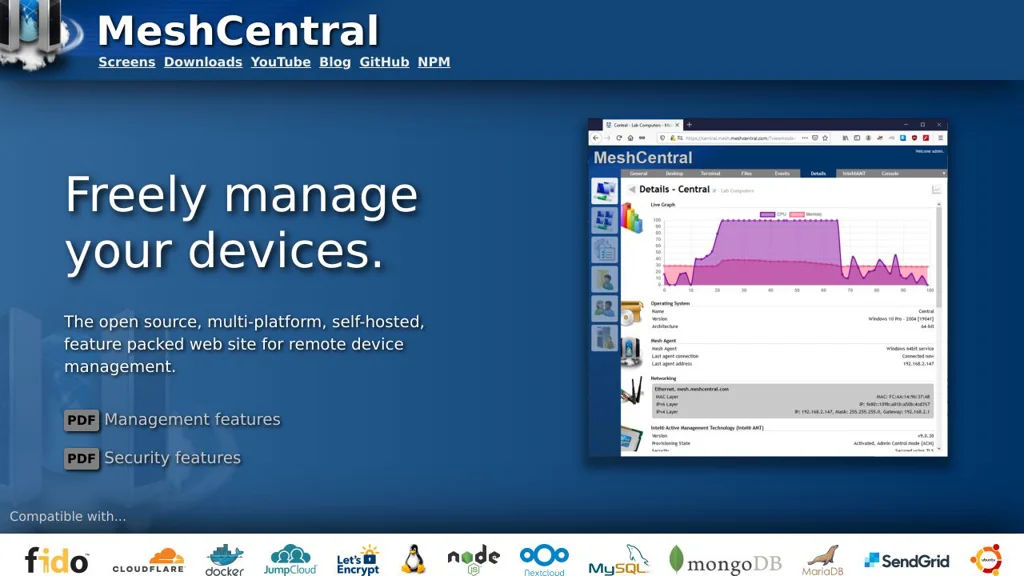
MeshCentral screenshot

MeshCentral is a web-based remote device management (RMM) and remote access platform that you host yourself. It provides a centralized server for enrolling devices and securely administering them through a browser, including interactive remote control and automation.

Key Features

  • Browser-based remote desktop/control for Windows, macOS, and Linux (agent-based)
  • Remote terminal/command execution and background device management actions
  • File transfer and file system browsing between admin and managed endpoints
  • Device inventory and status (hardware/software info, connectivity, last seen, etc.)
  • Multi-user management with roles, groups, and device “meshes” (organization)
  • Built-in relay for connectivity across NAT/firewalls; supports LAN discovery modes
  • Two-factor authentication options and detailed event/audit logging
  • Extensible via plugins/modules and integrates with Intel AMT for out-of-band management (where available)

Use Cases

  • Helpdesk/IT support for remote troubleshooting and user assistance
  • Managing fleets of servers, kiosks, lab PCs, or distributed endpoints
  • Remote administration of compatible Intel AMT/vPro devices for out-of-band access

Limitations and Considerations

  • Some advanced RMM functions (patching, AV/EDR, ticketing) are not a core focus compared to full commercial RMM suites
  • Intel AMT features depend on specific hardware/firmware support and correct network provisioning

MeshCentral is well-suited for teams that need a single, web-accessible console to enroll devices and perform secure remote support and administration. Its agent-based approach and optional AMT support make it flexible for both standard endpoint management and certain out-of-band scenarios.

5.9kstars
776forks
#2
WeTTY

WeTTY

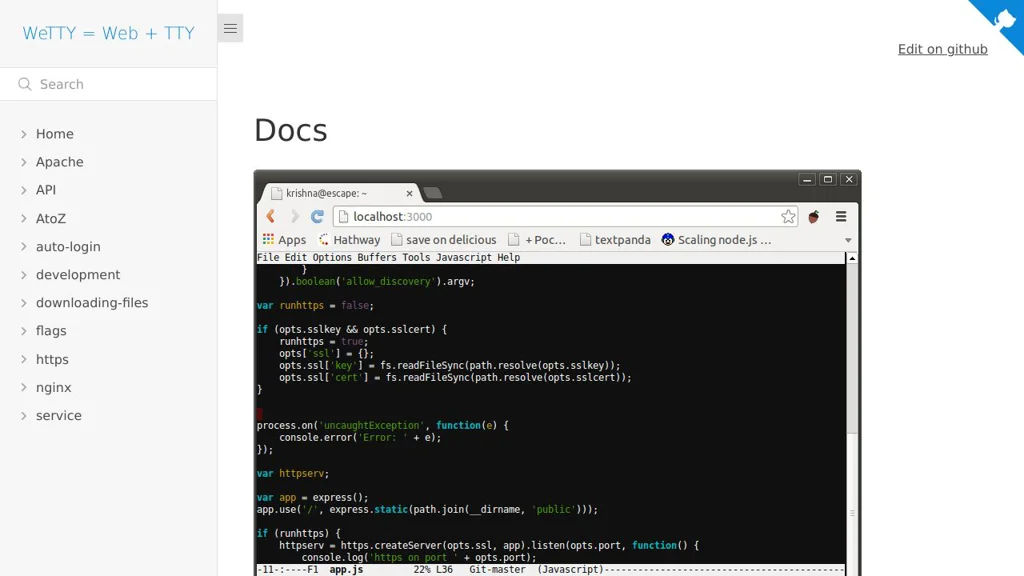
WeTTY provides a browser-based SSH terminal so you can access remote shells over HTTPS with optional authentication and proxy support.

WeTTY screenshot

WeTTY is a web terminal that lets you access SSH sessions directly from a browser. It runs as a small Node.js web app and bridges the browser to SSH, making it useful for lightweight remote administration without installing a local SSH client.

Key Features:

  • Browser-based SSH terminal UI for interactive shell access
  • Uses a local SSH client under the hood to connect to remote hosts
  • Optional HTTP authentication to protect access to the web terminal
  • Supports connection presets/parameters via URL options (useful behind portals)
  • Reverse-proxy friendly deployment (commonly used behind Nginx/Traefik)
  • Container-friendly setup (commonly deployed via Docker)

Use Cases:

  • Provide “jump host” terminal access from a web portal for admins/operators
  • Embedded terminal access in internal tools, dashboards, or support environments
  • Quick remote access from locked-down machines where installing SSH clients is not possible

Limitations and Considerations

  • Exposing SSH in a browser increases security risk; it should be tightly access-controlled and ideally placed behind SSO/VPN/reverse-proxy auth.
  • Feature set is intentionally minimal compared to full remote access gateways (audit, session recording, RBAC depend on external components).

WeTTY is a practical, lightweight way to deliver SSH access over the web with minimal infrastructure. It fits best for small teams or internal environments that need a simple web terminal front-end while keeping SSH as the underlying transport.

5.1kstars
741forks
#3
Apache Guacamole

Apache Guacamole

Web-based remote access gateway that provides clientless RDP, VNC, and SSH sessions via a browser, with centralized authentication and connection management.

Apache Guacamole screenshot

Apache Guacamole is a clientless remote desktop gateway that provides access to machines over standard protocols like RDP, VNC, and SSH directly from a web browser. It centralizes connection management and authentication, allowing users to reach remote desktops and terminals without installing native client software.

Key Features

  • Browser-based access (“clientless”): no plugins or local clients required
  • Supports RDP, VNC, and SSH through the guacd proxy/daemon
  • Central connection management (organize, share, and control access to connections)
  • Multiple authentication options via extensions (e.g., LDAP/Active Directory, RADIUS, SSO options)
  • Database-backed configuration (commonly MySQL/MariaDB or PostgreSQL via the web app)
  • Session features typically expected of remote access portals: clipboard integration, file transfer (protocol/extension dependent), and in-session controls
  • Auditing/visibility features via logs and extension ecosystem (deployment dependent)

Use Cases

  • Provide a secure, browser-based jump host for admins to reach servers/desktops
  • Offer helpdesk/IT remote access to internal machines without distributing VPN/RDP clients
  • Enable BYOD access to lab/VDI resources through a controlled web portal

Limitations and Considerations

  • Some capabilities (SSO methods, advanced auditing, storage integrations) depend on installing/configuring specific extensions and external identity systems
  • Performance/UX is workload- and network-dependent (especially for graphics-heavy desktops), and tuning (RDP settings, compression) may be required

Guacamole is widely used as a remote access gateway because it is protocol-focused, browser-native, and extensible through an established server/webapp architecture. It fits organizations needing centralized, controlled remote access while keeping endpoints lightweight.

3.7kstars
731forks
#4
ShellHub

ShellHub

ShellHub is a self-hosted SSH access gateway for managing and auditing remote access to servers and IoT devices with RBAC, device inventory, and session visibility.

ShellHub screenshot

ShellHub is a centralized SSH access gateway and device management platform designed to control, simplify, and audit remote access to servers and IoT/edge devices. It provides a web-based control plane where devices enroll and users connect through controlled, policy-based access.

Key Features

  • Device onboarding and inventory with identification and metadata
  • SSH access brokerage (gateway) to enrolled devices without exposing them directly
  • Web interface to manage devices, users, and access policies
  • Role-based access control (RBAC) for organizing and restricting access
  • Session visibility/auditing capabilities (connection and access tracking)
  • Multi-device fleet management oriented to IoT/edge environments

Use Cases

  • Centralize SSH access to production servers with controlled entry points
  • Manage remote access to IoT/edge fleets (industrial gateways, kiosks, routers)
  • Provide auditable operator/vendor access to customer or branch devices

Limitations and Considerations

  • Feature depth and enterprise controls can vary by edition/version; verify required auditing/recording needs in the current release.

ShellHub fits teams that want a single place to enroll devices and broker SSH access with governance controls. It’s especially useful where devices are distributed, behind NAT, or otherwise difficult to access directly, and where access control and traceability matter.

1.9kstars
169forks

Why choose an open source alternative?

  • Data ownership: Keep your data on your own servers
  • No vendor lock-in: Freedom to switch or modify at any time
  • Cost savings: Reduce or eliminate subscription fees
  • Transparency: Audit the code and know exactly what's running