
#1
UpSnap
Self-hosted Wake-on-LAN dashboard to wake, shutdown, reboot, and monitor devices, with groups, scheduled tasks, and user access control.
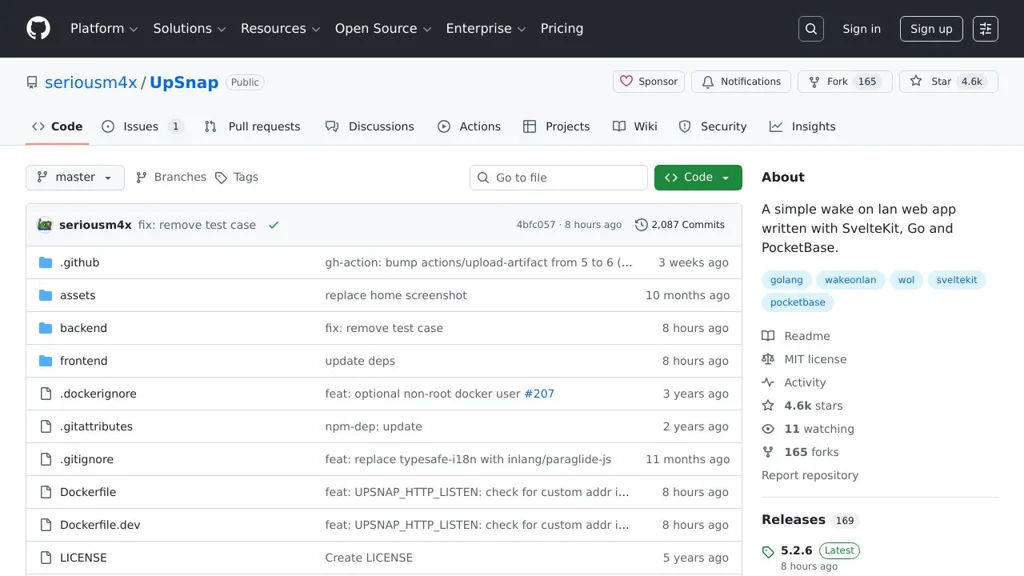
UpSnap is a self-hosted web application for managing devices on your network with Wake-on-LAN and remote power actions. It provides an inventory-style UI to organize machines, trigger actions, and automate common “power on/off” routines for homelabs and small offices.
Key Features:
- Wake-on-LAN (WOL) to power on devices by MAC address
- Remote actions for supported hosts (e.g., shutdown/reboot via configured methods)
- Device organization with groups/tags and searchable list views
- Scheduling/automation for recurring power tasks (e.g., start lab machines before work)
- User management and authentication with role-based access control (RBAC)
- API support for integrating wake/power actions into scripts and automations
- Docker-based deployment with persistent storage for configuration
Use Cases:
- Power up a homelab cluster or NAS on demand from a phone/desktop
- Automate “office hours” startup/shutdown schedules for lab/SMB devices
- Provide a shared dashboard for family/team members to start allowed machines
Limitations and Considerations:
- Remote shutdown/reboot capabilities depend on host OS configuration and the enabled control methods; WOL requires compatible hardware and network setup (BIOS/UEFI, NIC, VLAN/broadcast).
UpSnap fits teams that want a simple, centralized web UI for WOL and basic power orchestration without standing up a full monitoring or configuration-management stack. It is particularly useful in homelabs and small networks where device lifecycle (on/off) control is a frequent task.
4.6kstars
165forks