
Ultimaker Digital Factory

Best Self Hosted Alternatives to Ultimaker Digital Factory

A curated collection of the 2 best self hosted alternatives to Ultimaker Digital Factory.

Ultimaker Digital Factory is a cloud-based 3D printing management platform for teams. It centralizes print file storage, remote printer monitoring and control, slicing, print queue management, user permissions and firmware updates to streamline production workflows.

Alternatives List

#1
OctoPrint

OctoPrint

Self-hosted web server for 3D printer remote control, monitoring, timelapse recording, and an extensive plugin ecosystem.
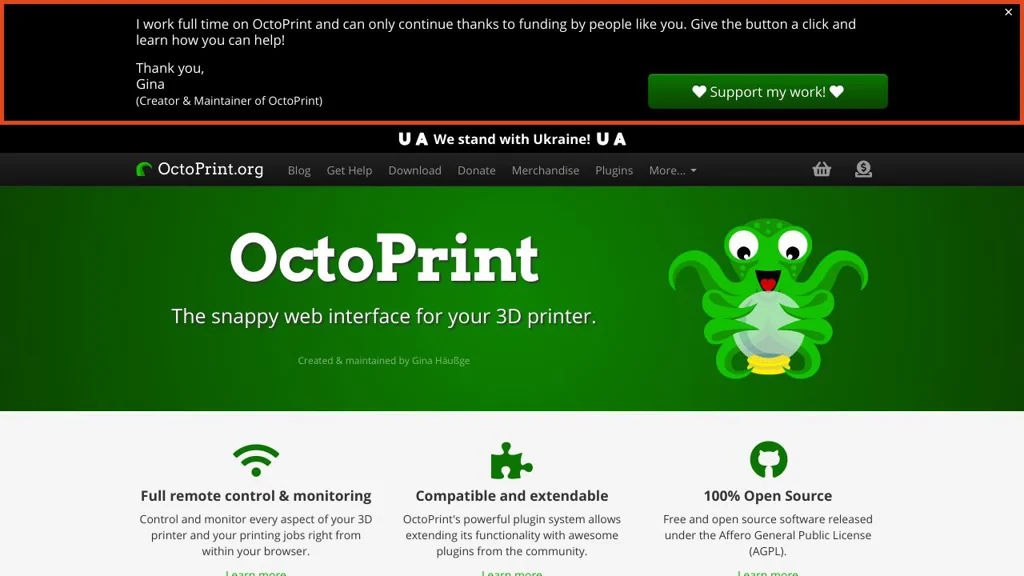
OctoPrint screenshot

OctoPrint is a web-based host software for 3D printers that lets you control, monitor, and manage print jobs over the network via a browser. It connects to your printer (typically over USB) and provides a central UI for uploading G-code, starting/stopping prints, and observing progress.

Key Features

  • Web UI for printer control (connect/disconnect, jog axes, temperature control, fan control)
  • G-code file management and print job queueing from a browser
  • Live monitoring with webcam support and timelapse recording
  • Built-in user accounts and permission system for multi-user access
  • Plugin system with a large ecosystem to extend functionality (UI, integrations, automation, printer features)
  • Event hooks and APIs (incl. REST-style API) for integrations and automation
  • Terminal/serial console and logging tools for troubleshooting printer communication

Use Cases

  • Run and supervise a home or makerspace 3D printer remotely from any device on the LAN
  • Add camera monitoring and timelapses for print documentation and failure review
  • Integrate printing into automations (notifications, job status, farm dashboards) via plugins/API

Limitations and Considerations

  • Requires a host device connected to the printer (commonly a Raspberry Pi) and depends on stable USB/serial communication
  • Features and reliability can depend on printer firmware, hardware, and installed plugins

OctoPrint is widely used in the 3D printing community as a flexible, extensible control plane for single printers or small setups. Its mature web UI and plugin ecosystem make it a common choice for adding remote management and monitoring without changing printer firmware.

8.8kstars
1.7kforks

#2
Manyfold

Manyfold

Self-hosted web app to catalog, tag, and preview 3D printable models with metadata, searching, and optional integrations for slicers and printers.

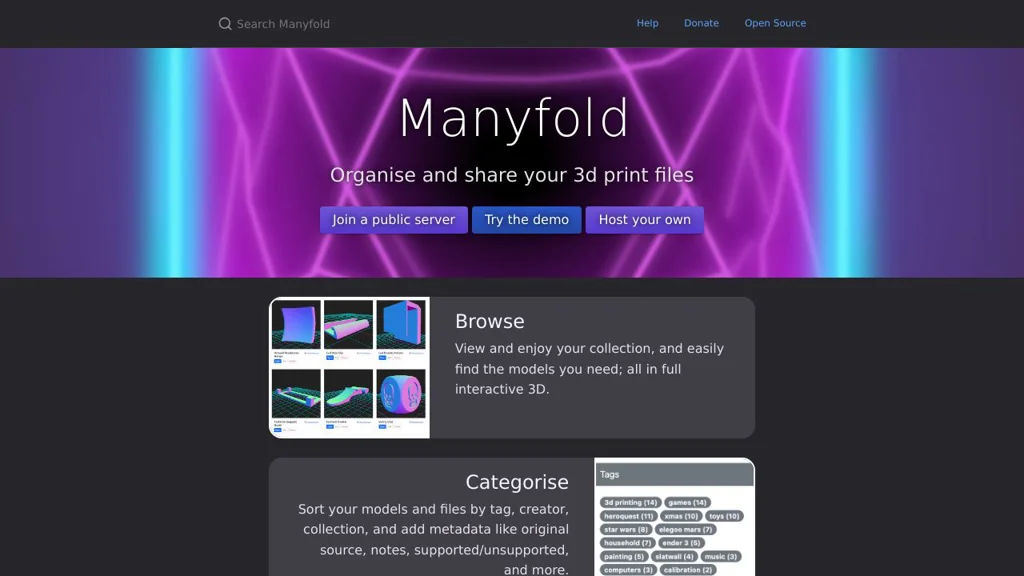
Manyfold screenshot

Manyfold is a self-hosted web application for building a searchable library of 3D models (especially for 3D printing). It focuses on organizing files and metadata so you can quickly find, preview, and manage models across collections and storage locations.

Key Features

  • Library/catalog for 3D model files with rich metadata (title, description, tags)
  • Upload and manage common 3D formats (project-dependent) with model pages
  • 3D preview in the browser for supported formats
  • Full-text search and filtering across your collection
  • Import/scan workflows to bring existing folders of models into the catalog
  • Multi-user support with authentication and permissions (project-dependent)
  • Docker-based deployment options and configuration via environment variables

Use Cases

  • Maintain a private “Thingiverse/Printables-like” index of your personal STL/3MF archive
  • Team/shared makerspace catalog to track models, versions, and printable assets
  • Curate themed collections (miniatures, functional parts, upgrades) with tags and search

Limitations and Considerations

  • Exact supported file formats and integrations depend on the current release; verify against the project docs before migrating a large library.

Manyfold is best suited for makers who already have many model files spread across disks or NAS storage and want a fast, web-based way to browse and retrieve them. It provides a structured catalog layer on top of your existing files to reduce duplication and improve discoverability.

1.7kstars
99forks

Why choose an open source alternative?

  • Data ownership: Keep your data on your own servers
  • No vendor lock-in: Freedom to switch or modify at any time
  • Cost savings: Reduce or eliminate subscription fees
  • Transparency: Audit the code and know exactly what's running