
Versionista

Best Self Hosted Alternatives to Versionista

A curated collection of the 2 best self hosted alternatives to Versionista.

Versionista monitors websites for content and code changes, offering automated change detection, visual and text diffs, alerts, archiving, RSS and compliance reporting to help teams track updates, regulatory/legal changes, and unauthorized modifications.

Alternatives List

#1
ChangeDetection.io

ChangeDetection.io

Self-hosted website change detection and monitoring with visual diffs, filters, and notifications via email and popular chat/webhook services.

ChangeDetection.io screenshot

ChangeDetection.io is a self-hosted web app that watches web pages for changes and alerts you when content updates. It is commonly used to track price changes, availability, announcements, and updates on pages that do not provide RSS feeds.

Key Features

  • Monitor URLs on a schedule and trigger notifications when changes are detected
  • Visual change detection (screenshot-based) and text/HTML change detection modes
  • Diffs and history: view what changed over time with change snapshots
  • CSS/XPath/JSONPath targeting and “ignore/filters” to reduce noise (e.g., remove dynamic elements)
  • Supports pages requiring JavaScript rendering via a browser automation backend (Playwright)
  • Notification integrations including email, webhooks, and common chat/incident endpoints (via Apprise)
  • Optional proxy support for fetching pages
  • Import/export and organization tools for managing many watches

Use Cases

  • Track price/stock changes on ecommerce product pages
  • Watch government/company announcement pages for updates
  • Monitor internal or external web pages for regressions or unexpected content changes

Limitations and Considerations

  • JavaScript-rendered monitoring requires running a browser automation component (higher CPU/RAM than simple fetches)
  • Highly dynamic pages may require careful filtering/targeting to avoid frequent false positives

ChangeDetection.io provides a focused interface for building reliable “watches” on web content, combining diff/history views with robust filtering and broad notification support. It is a practical replacement for hosted change-monitoring services when you want control over scheduling, data retention, and integrations.

29.8kstars
1.6kforks

#2
RSS Bridge

RSS Bridge

RSS Bridge creates RSS/Atom feeds from websites and platforms that lack feeds, using site-specific “bridges” and a simple HTTP interface for aggregators and automation.

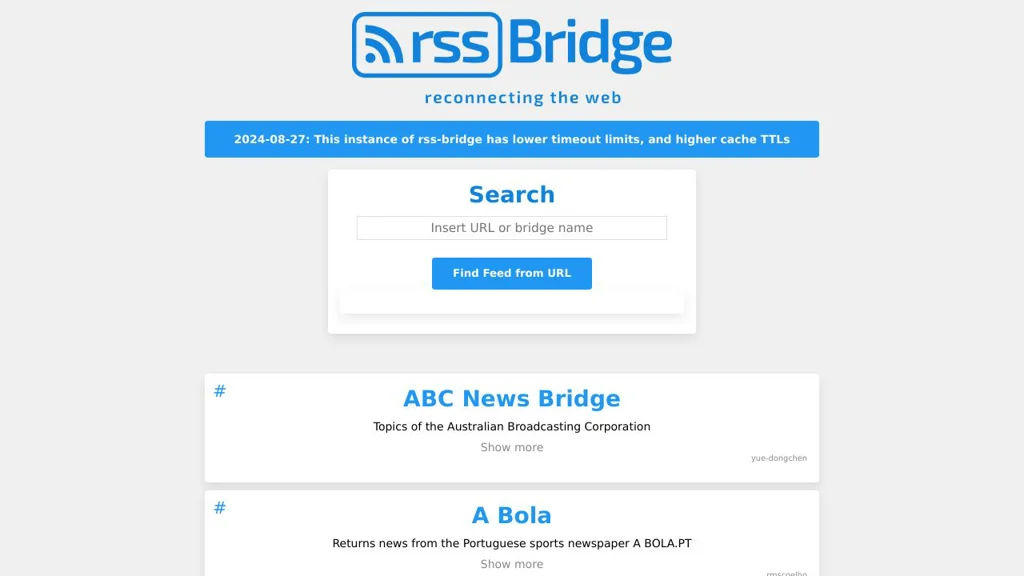
RSS Bridge screenshot

RSS Bridge is a PHP application that turns web pages and platform endpoints into RSS or Atom feeds. It provides a catalog of site-specific “bridges” (scrapers/adapters) and a uniform HTTP interface so feed readers and automations can subscribe to sources that otherwise have no feed.

Key Features

  • Large collection of configurable “bridges” that generate RSS/Atom from specific websites and services
  • Outputs RSS 2.0 and Atom feeds via simple URLs, suitable for any RSS reader
  • Parameterized feeds (e.g., user, tag, search, section) depending on the selected bridge
  • Built-in caching to reduce remote requests and speed up repeated feed generation
  • Optional authentication and access control options (deploy-time configuration)
  • Extensible architecture: create custom bridges by implementing the Bridge interface (project templates and examples in repo)
  • Multiple deployment options (classic PHP hosting, Docker image, docker-compose examples)

Use Cases

  • Subscribe to updates from websites that do not publish RSS/Atom feeds
  • Convert social/profile pages, search pages, or category listings into feeds for a reader or notification system
  • Build lightweight automation pipelines (e.g., “new item in feed → webhook/IFTTT/Zapier alternative”) using standard RSS tooling

Limitations and Considerations

  • Feed quality depends on each bridge’s scraping logic; upstream website changes can break individual bridges
  • Some sources may rate-limit or block scraping, requiring caching/tuning or may not work reliably

RSS Bridge is commonly used as a compatibility layer between modern websites and RSS-based workflows. Its bridge ecosystem and uniform feed endpoints make it practical for personal monitoring, news aggregation, and automation where official feeds or APIs are missing.

8.6kstars
1.2kforks

Why choose an open source alternative?

  • Data ownership: Keep your data on your own servers
  • No vendor lock-in: Freedom to switch or modify at any time
  • Cost savings: Reduce or eliminate subscription fees
  • Transparency: Audit the code and know exactly what's running