
Syncthing
Continuous peer-to-peer file synchronization
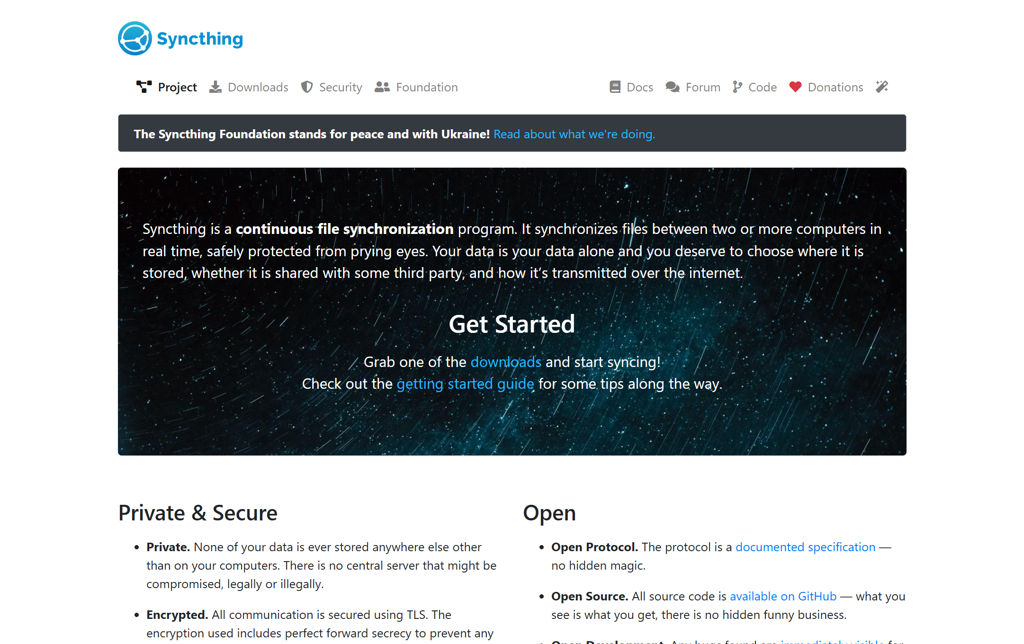
Syncthing is a continuous file synchronization tool that keeps selected folders in sync between two or more devices. It uses a peer-to-peer model (no mandatory central server), focusing on privacy, resiliency, and cross-platform support for desktops, servers, and mobile devices.
Key Features
- Peer-to-peer folder synchronization between trusted devices (device IDs) without relying on a central storage provider
- Encrypted transport (TLS) and device authentication via cryptographic device identities
- Web-based GUI for configuration/monitoring plus a REST API and event stream for automation/monitoring integrations
- NAT traversal and relay support to connect devices across networks (global discovery and optional relay usage)
- Versioning options for deleted/overwritten files (simple, staggered, trash can, external)
- Per-folder controls: ignore patterns, file/folder permissions handling, rescan intervals, selective folder sharing
- Cross-platform binaries and packaging for common OSes; runs well on headless servers
Use Cases
- Sync a “working files” directory between a laptop and a home server without using Dropbox/Drive
- Keep a replicated copy of important folders across multiple machines as a lightweight redundancy layer
- Maintain shared folders between a small number of trusted devices (e.g., family/workstations)
Limitations and Considerations
- It is not a multi-user collaboration/groupware platform; sharing is based on explicitly trusted device pairs
- Conflicts can occur with concurrent edits; Syncthing creates conflict copies rather than merging content
Syncthing fits users who want direct device-to-device synchronization with strong transport security and operational transparency. It’s especially useful when you want cloud-like syncing behavior while keeping storage and control on your own devices.
Categories:
Tags:
Tech Stack:
 TLS
TLS Go
Go JavaScript
Similar Services

Supabase
Open-source Firebase alternative built on Postgres
Self-hostable backend platform combining Postgres, Auth, Storage, realtime APIs, edge functions, and an admin dashboard to build and scale apps quickly.


Immich
Self-hosted photo and video backup with AI search
A self-hosted photos and videos platform for automatic mobile backup, fast browsing, and AI-powered search, with sharing and albums similar to Google Photos.


MinIO
High-performance S3-compatible object storage
Self-hosted, S3-compatible object storage server for cloud-native workloads with replication, versioning, encryption, and Kubernetes-friendly deployment.


copyparty
Portable file server with upload, WebDAV, and media indexing
A lightweight, portable web-based file server with uploads, WebDAV, search, and optional media indexing—designed to run anywhere with minimal dependencies.


PhotoPrism
AI-powered photo management for the decentralized web
Self-hosted photo management and gallery app with AI search, automatic organization, and multi-user support for large photo and video libraries.

Puter
Self-hostable personal cloud with a web desktop
A self-hostable personal cloud that provides a web-based desktop, file storage, apps, and multi-user access in the browser.
