Google Calendar appointment scheduling

Best Self Hosted Alternatives to Google Calendar appointment scheduling

A curated collection of the 3 best self hosted alternatives to Google Calendar appointment scheduling.

Google Calendar appointment scheduling lets users create bookable appointment slots or appointment schedules that others can reserve, simplifying meeting bookings and calendar management for individuals and organizations.

Alternatives List

#1
Easy!Appointments

Easy!Appointments

Open-source appointment scheduling software with provider services, working plans, email notifications, and Google Calendar sync for online bookings.
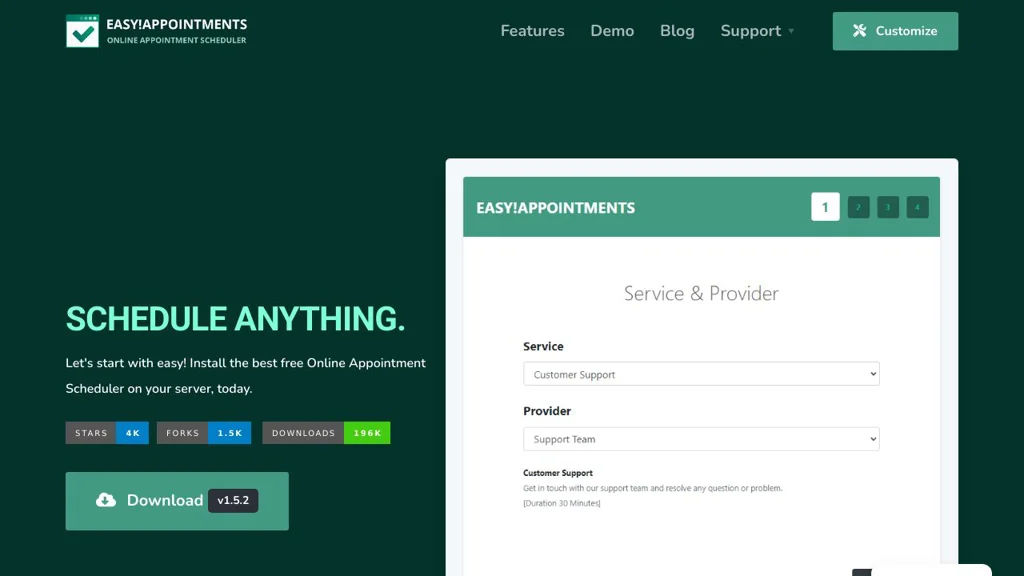
Easy!Appointments screenshot

Easy!Appointments is a web-based appointment scheduling application designed for businesses that need online bookings with staff/provider availability. It lets you define services, providers, and working plans, then exposes a booking page customers can use to reserve time slots.

Key Features

  • Public booking page for customers to schedule appointments based on real availability
  • Management backend for services, providers, customers, and appointments
  • Working plans, breaks, and time-slot rules to control provider availability
  • Email notifications for bookings and changes (SMTP-based)
  • Google Calendar synchronization (two-way sync via Google API) for providers
  • Multi-user administration with roles (e.g., admin/provider) and user management
  • Multi-language UI support (translations) and configurable date/time formats
  • REST API endpoints for integrating bookings with external systems

Use Cases

  • Service businesses (salons, clinics, consultants) offering online appointment booking
  • Teams with multiple staff/providers needing centralized availability management
  • Organizations integrating scheduling into an existing website/app via API

Limitations and Considerations

  • Focused on appointment booking; it is not a full CRM or payments/invoicing system
  • Google Calendar sync requires Google API credentials and configuration

Easy!Appointments provides a practical, lightweight booking workflow that can be embedded into a website and managed through an admin panel. It is well-suited for small to mid-sized organizations that want control over scheduling data and straightforward integrations.

4kstars
1.5kforks

#2
Baïkal

Baïkal

Baïkal is a lightweight CalDAV/CardDAV server for syncing calendars, tasks, and contacts with DAV clients, with a simple web admin UI and multi-user support.

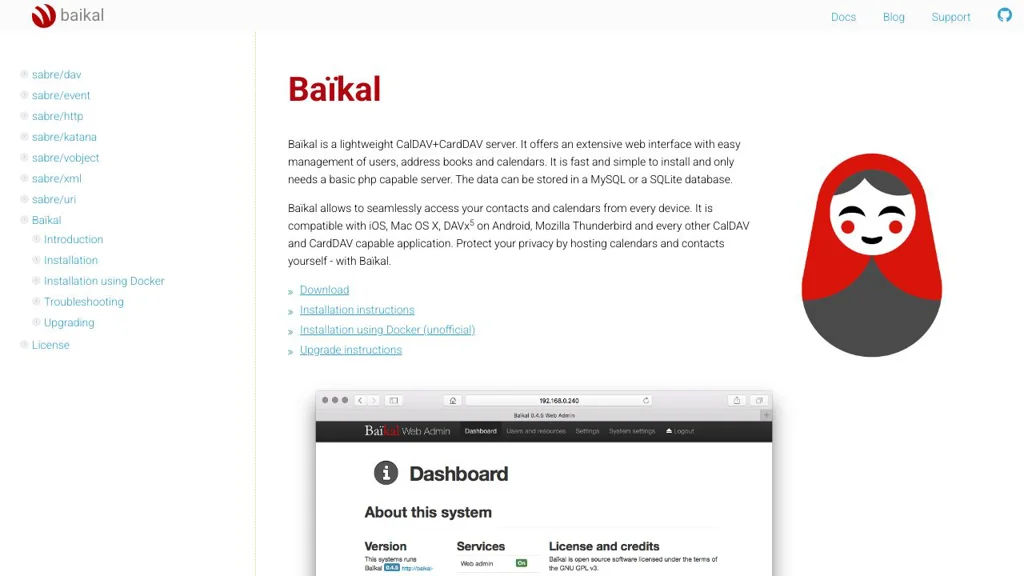
Baïkal screenshot

Baïkal is a small, self-hostable groupware backend that provides CalDAV and CardDAV services for syncing calendars, tasks, and contacts across devices and desktop/mobile clients. It is built on top of the SabreDAV stack and is designed to be easy to deploy and administer.

Key Features

  • CalDAV server for calendars and tasks (VTODO) compatible with common DAV clients
  • CardDAV server for contact sync using vCard
  • Web-based administration panel to create/manage users, address books, and calendars
  • Multi-user support with per-user collections (calendars/address books)
  • Uses an SQL database backend (SQLite by default; also supports MySQL and PostgreSQL)
  • Standards-based DAV interoperability via the SabreDAV library

Use Cases

  • Sync personal calendars/tasks between macOS/iOS, Android (DAVx⁵), and desktop clients
  • Provide shared calendars/contacts for a family or small team without a full groupware suite
  • Run a lightweight DAV endpoint behind an existing web server/reverse proxy

Limitations and Considerations

  • Focused specifically on CalDAV/CardDAV; it is not a full mail/chat/collaboration suite
  • Interoperability depends on client DAV support; some clients may require extra configuration

Baïkal is a good fit when you want standards-based calendar/contact synchronization with minimal overhead. Its simple admin UI and SabreDAV foundation make it practical for small deployments that need reliable DAV services without additional groupware components.

3kstars
304forks
#3
sabre/dav

sabre/dav

A PHP library for building WebDAV, CalDAV, and CardDAV servers with RFC-compliant protocol support, extensible plugins, and integration with existing authentication and storage backends.

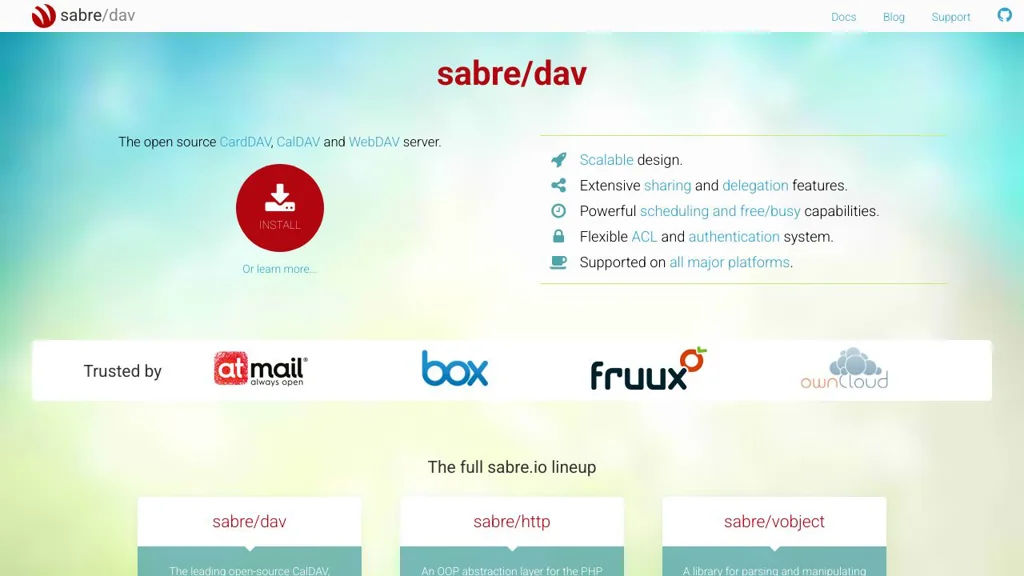
sabre/dav screenshot

sabre/dav is a PHP library for implementing WebDAV, CalDAV, and CardDAV servers. It provides the protocol handling, routing, and interoperability layers needed to expose files, calendars, and address books to standard clients while letting you plug in your own storage and authentication.

Key Features

  • WebDAV server framework with support for common clients (e.g., Windows/macOS/WebDAV tools)
  • CalDAV (calendar) and CardDAV (contacts) protocol implementations for sync to desktop/mobile clients
  • Pluggable architecture (server “plugins”) for adding features such as authentication, ACL, locks, sync reports, etc.
  • Backend abstraction: implement interfaces to connect calendars/contacts/files to your database or filesystem
  • Standards-focused design with broad RFC coverage and strong emphasis on interoperability
  • Ships as a Composer package for embedding into custom PHP applications

Use Cases

  • Add CalDAV/CardDAV sync (calendars/contacts) to an existing PHP product
  • Provide a WebDAV endpoint for document access/editing from desktop/mobile clients
  • Build a lightweight groupware sync layer backed by custom storage and auth

Limitations and Considerations

  • It is a developer-focused library rather than a complete “ready-to-run” end-user server; you typically need to implement storage backends and deploy within your own PHP application.

sabre/dav is best suited when you need standards-compliant DAV capabilities inside a PHP stack and want control over authentication, data models, and persistence. Its plugin system and backend interfaces make it adaptable to many architectures while retaining protocol correctness.

1.7kstars
362forks

Why choose an open source alternative?

  • Data ownership: Keep your data on your own servers
  • No vendor lock-in: Freedom to switch or modify at any time
  • Cost savings: Reduce or eliminate subscription fees
  • Transparency: Audit the code and know exactly what's running