
Microsoft Dynamics 365 Business Central

Best Self Hosted Alternatives to Microsoft Dynamics 365 Business Central

A curated collection of the 4 best self hosted alternatives to Microsoft Dynamics 365 Business Central.

Microsoft Dynamics 365 Business Central is a cloud-based ERP for small and mid-sized businesses that unifies finance, sales, service, project management, supply chain and operations. It automates processes, delivers real-time insights, and integrates with Microsoft 365 and Power Platform.

Alternatives List

#1
Odoo

Odoo

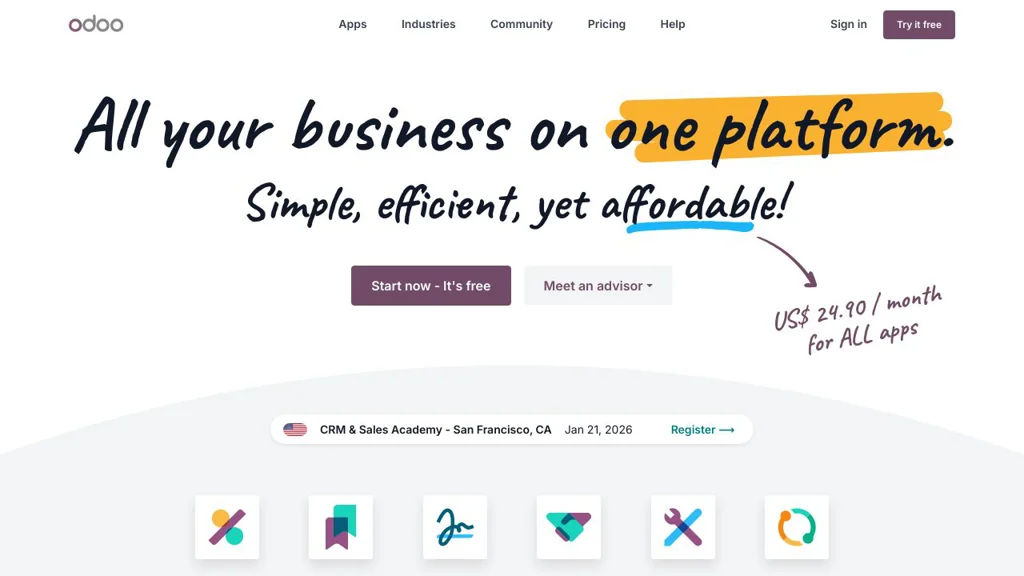
Odoo is a modular ERP and business app suite covering CRM, sales, accounting, inventory, manufacturing, HR, eCommerce, and website building with a unified database and extensible framework.
Odoo screenshot

Odoo is a modular enterprise resource planning (ERP) platform that bundles a large suite of business applications (CRM, Sales, Accounting, Inventory, Manufacturing, HR, eCommerce, Website, and more) into a single system. It is designed around a unified data model so departments can share workflows, reporting, and automations across apps.

Key Features

  • Large catalog of installable business apps (CRM, Sales, Accounting/Invoicing, Inventory/WMS, MRP, Purchase, HR, Project, Helpdesk, Website/eCommerce)
  • Single database and integrated workflows across modules (e.g., sales → invoicing → delivery → accounting)
  • Highly extensible server framework with custom modules, views, and business logic
  • Built-in access control and multi-company support for managing multiple entities
  • Web client with responsive UI, dashboarding, and reporting across business data
  • Internationalization support (multi-language) and localization packages for many countries

Use Cases

  • Replace disconnected tools with one ERP for sales, invoicing, purchasing, inventory, and accounting
  • Run end-to-end operations for SMBs (quotations, orders, stock, manufacturing, shipping)
  • Build custom line-of-business apps on top of Odoo’s modular framework

Limitations and Considerations

  • Some advanced features and apps are only available in Odoo Enterprise; the GitHub repo is the Community edition codebase
  • Upgrades between major versions can require migration work, especially with custom modules

Odoo is a broad, integrated business platform that can scale from small companies to complex multi-company setups. Its modular architecture allows starting with a few apps and expanding into a full ERP as needs grow.

48.3kstars
31kforks

#2
Dolibarr

Dolibarr

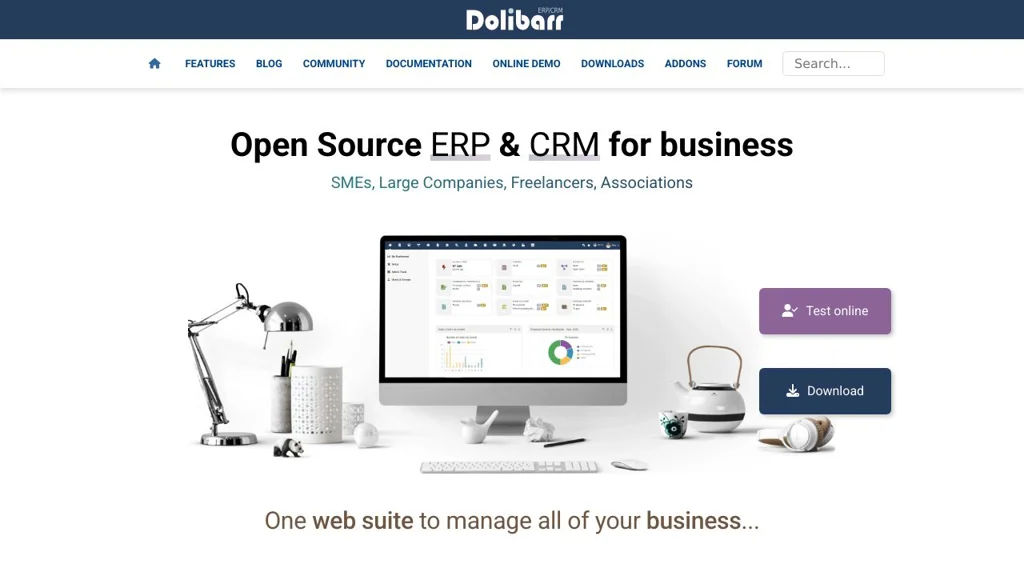
Dolibarr is a modular ERP/CRM for SMBs to manage sales, invoicing, inventory, projects, accounting, and more via a web interface with optional modules.

Dolibarr screenshot

Dolibarr is a modular web-based ERP and CRM designed for small and medium-sized businesses, freelancers, and associations. It provides core business management features (sales, invoicing, products, accounting, projects, etc.) and can be extended via optional modules.

Key Features

  • ERP + CRM in one application: leads/opportunities, customers, proposals/quotes, sales orders, and invoices
  • Product and service catalog with stock/inventory management and warehouses
  • Finance features including bank/cash management and expense tracking; accounting features available via modules
  • Project and task management with time tracking and simple collaboration features
  • Document generation (PDFs) for quotes/invoices and email sending from within the app
  • Modular architecture: enable only needed features; additional modules available from the ecosystem/marketplace
  • Multi-company (multi-entity) capability available via module, plus multi-currency and multi-language support
  • User/role permissions and auditability-oriented controls suitable for business workflows

Use Cases

  • Run a small business back office: CRM → quote → order → invoice → payment tracking
  • Manage products/services and stock across one or more warehouses while invoicing customers
  • Track projects, tasks, and time spent for service delivery and billable work

Limitations and Considerations

  • Depth and compliance-grade accounting features depend on configuration and optional modules; suitability varies by country
  • The large module ecosystem can require careful selection and administration to avoid feature overlap

Dolibarr is a strong fit when you want a single, lightweight web ERP/CRM that can be expanded gradually. Its modular approach makes it practical for organizations that prefer to start simple and add capabilities as processes mature.

6.8kstars
3.2kforks
#3
InvenTree

InvenTree

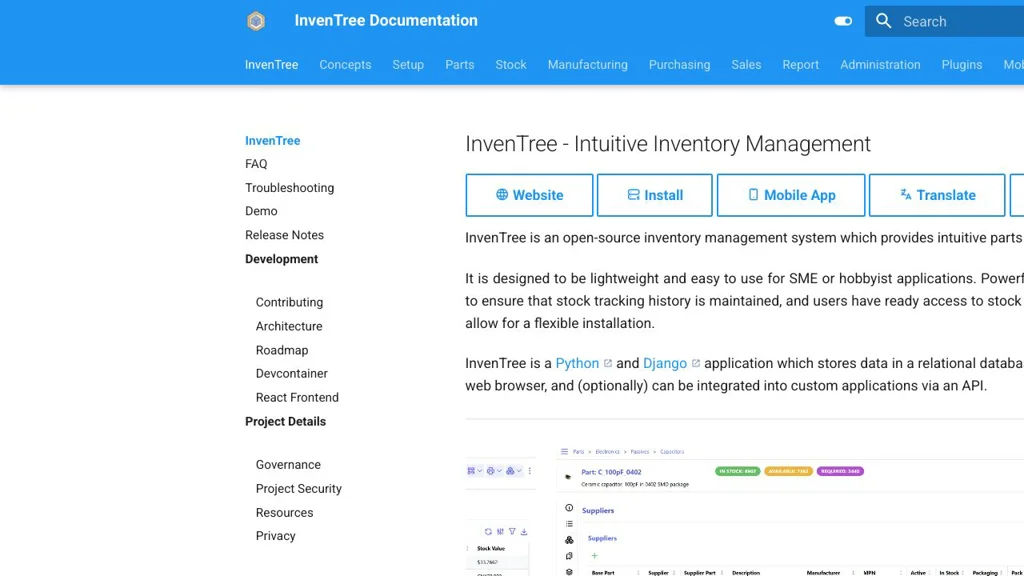
Self-hosted inventory, BOM, and manufacturing/traceability system for parts, assemblies, stock control, and purchasing, with APIs and barcode support.

InvenTree screenshot

InvenTree is a web-based inventory management system focused on parts, assemblies, and manufacturing workflows. It helps teams track component data, stock levels and locations, BOMs, suppliers, purchasing, and production builds with traceability.

Key Features

  • Parts catalog with parameters/metadata, internal part numbering, attachments, and revision history
  • Stock management with locations, status, allocations, and stock tracking per part
  • Bill of Materials (BOM) management for assemblies, including sub-assemblies and BOM validation
  • Manufacturing/build workflows with build orders, consumption of stock, and output tracking
  • Purchasing and supplier management (supplier parts, pricing breaks, manufacturer part info)
  • Sales/orders support for allocating stock to customer orders (where configured)
  • Barcode/label workflows (scan to find/move/consume stock; label generation)
  • REST API and integrations (e.g., external tools, ERP/light automation, scripting)
  • Role-based access control, multi-user operation, and audit/traceability features

Use Cases

  • Electronics/mechanical labs tracking parts, reels/bins, and BOMs for prototypes
  • Small manufacturers managing builds, stock consumption, and component traceability
  • Makerspaces tracking shared inventory, locations, and reorder processes

Limitations and Considerations

  • Feature depth is geared toward inventory/manufacturing; full ERP modules (finance/payroll) are out of scope
  • Some advanced workflows may require configuration, plugins, or custom integration via the API

InvenTree is well-suited for organizations that need accurate parts data, stock control, and BOM-driven production processes. Its web UI plus API and barcode-centric workflows make it practical for both day-to-day inventory operations and lightweight manufacturing execution.

6.2kstars
1.2kforks
#4
EspoCRM

EspoCRM

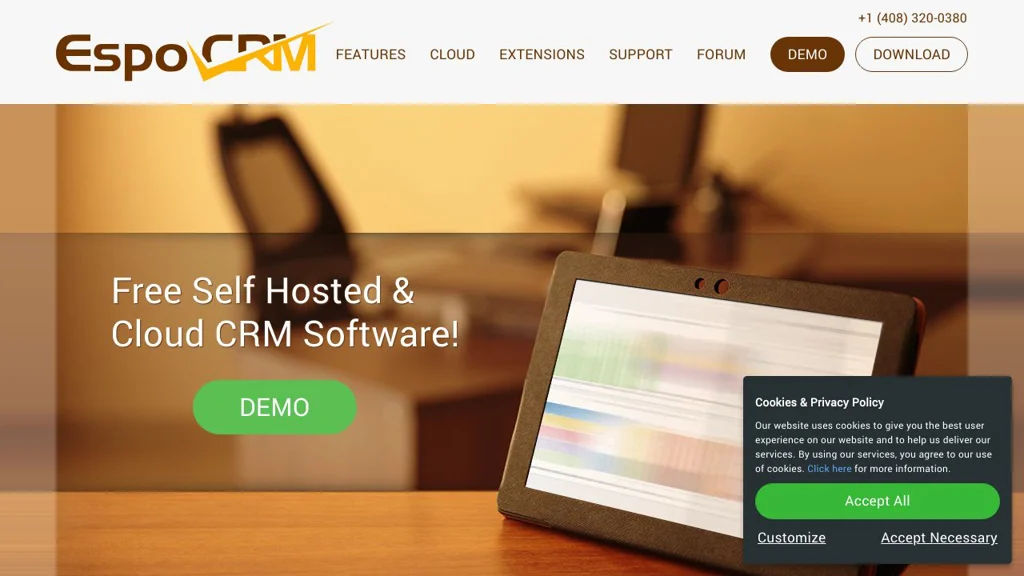
Self-hosted CRM with leads/opportunities, email & calendar sync, marketing automation, workflows, and extensible entity-based customization.

EspoCRM screenshot

EspoCRM is a self-hosted customer relationship management (CRM) platform focused on managing leads, accounts, contacts, opportunities, and customer interactions in a single system. It provides sales pipeline tools, email-centric communication features, and a flexible entity model that supports customization and extensions.

Key Features

  • Sales pipeline management with leads, opportunities, accounts/contacts, activities, and reporting dashboards
  • Email integration (IMAP/SMTP) with email archiving to CRM records and templates for outbound communication
  • Calendar and activities (calls, meetings, tasks) with scheduling and reminders
  • Workflow automation (rules/actions) and business process tools (BPM) for automating CRM operations
  • Role-based access control (teams, roles, permissions) and audit/logging capabilities
  • Custom entities, fields, layouts, relationships, and formulas for tailoring data model and UI
  • Extensions ecosystem (add-ons/modules) and API for integrations

Use Cases

  • Track B2B sales pipelines from lead capture through opportunity stages to close
  • Centralize customer communication by linking emails, calls, meetings, and notes to records
  • Automate routine CRM tasks (assignment, notifications, stage changes) with workflows

Limitations and Considerations

  • Some advanced capabilities are delivered via paid extensions; feature set depends on edition/modules enabled

EspoCRM fits teams that need a customizable, email-integrated CRM with strong automation options and an extensible architecture. It is particularly suitable for organizations wanting control over CRM data and flexible customization without building a CRM from scratch.

2.7kstars
785forks

Why choose an open source alternative?

  • Data ownership: Keep your data on your own servers
  • No vendor lock-in: Freedom to switch or modify at any time
  • Cost savings: Reduce or eliminate subscription fees
  • Transparency: Audit the code and know exactly what's running