#1
Odoo
Odoo is a modular ERP and business app suite covering CRM, sales, accounting, inventory, manufacturing, HR, eCommerce, and website building with a unified database and extensible framework.
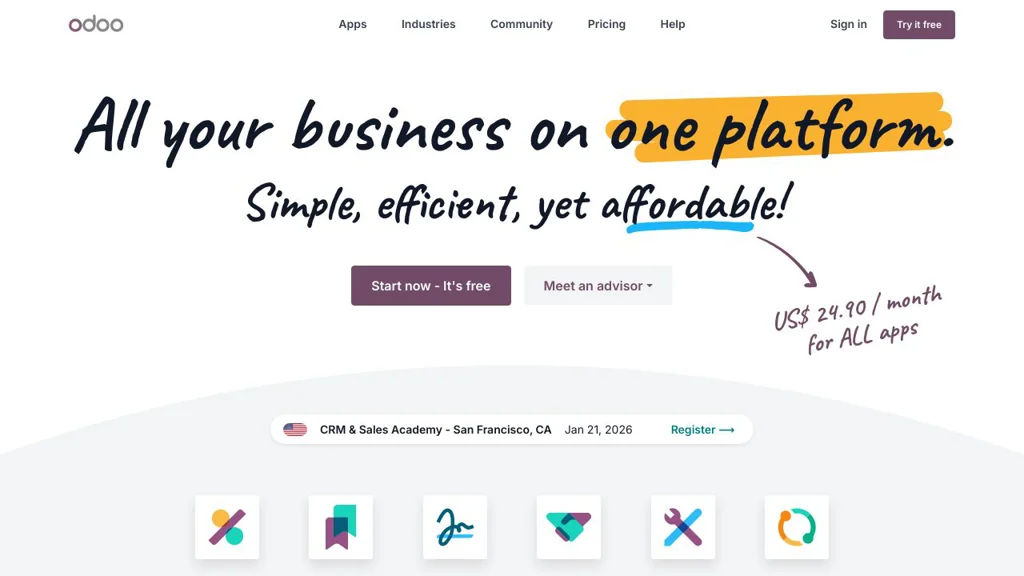
Odoo is a modular enterprise resource planning (ERP) platform that bundles a large suite of business applications (CRM, Sales, Accounting, Inventory, Manufacturing, HR, eCommerce, Website, and more) into a single system. It is designed around a unified data model so departments can share workflows, reporting, and automations across apps.
Key Features
- Large catalog of installable business apps (CRM, Sales, Accounting/Invoicing, Inventory/WMS, MRP, Purchase, HR, Project, Helpdesk, Website/eCommerce)
- Single database and integrated workflows across modules (e.g., sales → invoicing → delivery → accounting)
- Highly extensible server framework with custom modules, views, and business logic
- Built-in access control and multi-company support for managing multiple entities
- Web client with responsive UI, dashboarding, and reporting across business data
- Internationalization support (multi-language) and localization packages for many countries
Use Cases
- Replace disconnected tools with one ERP for sales, invoicing, purchasing, inventory, and accounting
- Run end-to-end operations for SMBs (quotations, orders, stock, manufacturing, shipping)
- Build custom line-of-business apps on top of Odoo’s modular framework
Limitations and Considerations
- Some advanced features and apps are only available in Odoo Enterprise; the GitHub repo is the Community edition codebase
- Upgrades between major versions can require migration work, especially with custom modules
Odoo is a broad, integrated business platform that can scale from small companies to complex multi-company setups. Its modular architecture allows starting with a few apps and expanding into a full ERP as needs grow.
48.3kstars
31kforks